Stay informed with free updates
Simply sign up to the US equities myFT Digest — delivered directly to your inbox.
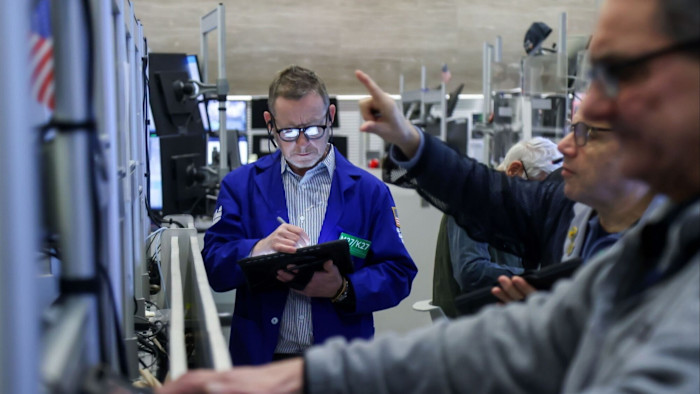
US bank stocks are on track for their worst sell-off since Donald Trump’s tariffs shook markets in April as concerns intensify around lenders’ exposure to a downturn in private credit sparked by AI disruption fears.
The KBW bank index, which includes the largest US banks such as JPMorgan, Citi and Bank of America, fell 5.4 per cent, on track for its biggest daily drop since the president’s “liberation day” tariff announcements 10 months ago sent Wall Street markets reeling.
Goldman Sachs slid 7.6 per cent, Wells Fargo lost 6.3 per cent and Morgan Stanley fell 6.5 per cent. Jefferies sunk more than 10 per cent.
Those declines came as US private capital giants, which have extended loans to software companies and are also holders of their equity, continued their weak start to the year.
KKR, Ares and Apollo were all down more than 6 per cent on Friday and Blackstone fell 4.3 per cent. Blue Owl shares, which declined 6 per cent on Friday, were on track for the biggest monthly decline since the company listed in 2021.
“The concern [for banks] is their exposure to private credit,” said Jim Caron, chief investment officer for Morgan Stanley Investment Management’s Portfolio Solutions.
So-called business development companies, funds that invest in private credit loans, have been hard hit this week as several large vehicles mark down distressed loans.
A large credit fund managed by KKR on Thursday reported a jump in troubled loans and lower investment income, adding to investor fears about the health of private markets, while a separate vehicle managed by Apollo also wrote down the value of some of its assets.
The sector has been under pressure since the Federal Reserve began cutting interest rates last year, with many of the vehicles slashing their dividends in tandem. BlackRock and Apollo trimmed the dividends on some of the funds they manage this week, which sent the shares of those vehicles down 9 per cent and 7 per cent, respectively.
Wall Street lenders were also rushing on Friday to understand the extent of losses on billions of pounds they lent to a UK-based mortgage provider that collapsed suddenly amid fraud allegations.
Companies including Barclays, Jefferies and Apollo’s Atlas SP Partners, its structured credit arm, extended £2bn of financing to Market Financial Solutions. The London-headquartered firm previously lent to a Bangladeshi politician before it collapsed into insolvency on Wednesday amid accusations of double-pledging of its collateral.
US tech stocks more broadly fell on Friday, heading for their worst month in almost a year, as investors’ fears about the economic fallout from AI combined with US-Iran conflict worries.
The Nasdaq Composite declined 1.3 per cent, taking its losses in February to nearly 4 per cent. The S&P 500 dipped 0.9 per cent. Both indices are on track to post their worst week since March 2025.
Stocks have been rocked this month by a number of scares over the potential for AI to disrupt entire industries, including software, insurance and wealth management. The resulting flight to safe assets has helped US Treasuries notch their strongest month in a year, with the 10-year yield falling below 4 per cent for the first time since November on Friday.
Investors seeking shelter from the stock market volatility on Friday piled into US government debt. The benchmark US 10-year yield fell 0.05 percentage points to 3.96 per cent, extending a strong run for government debt that has come in spite of signs of persistent inflation.
“When the going gets tough and investors need liquidity and safety against risk, the asset that performs best is US Treasuries,” said Edward Al-Hussainy, a portfolio manager at Columbia Threadneedle.
The two-year Treasury yield, which is particularly sensitive to monetary policy expectations, dropped 0.05 percentage points to 3.37 per cent, its lowest level since 2022. The move was echoed in the futures market, which together suggest investors are adding to bets on rate cuts this year, with the first forecast to come in July.
The stock sell-off has been “driven by a bearish narrative that AI would eliminate most white-collar jobs and eventually lead the economy into collapse”, Bank of America analysts wrote.
They added that the narrative was “at odds with sound economic theory” but that “crowded positioning” in the stock market was exacerbating the size of the moves.