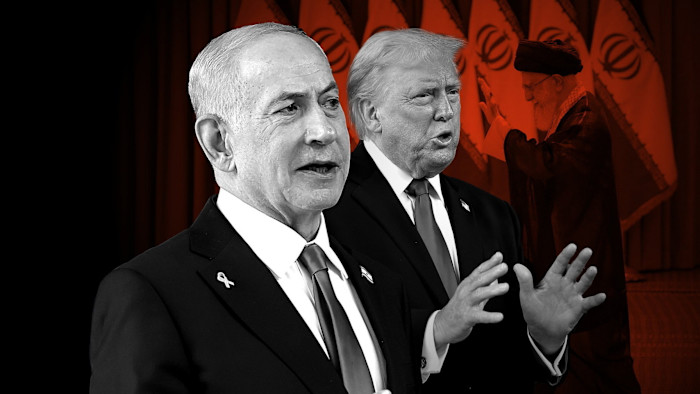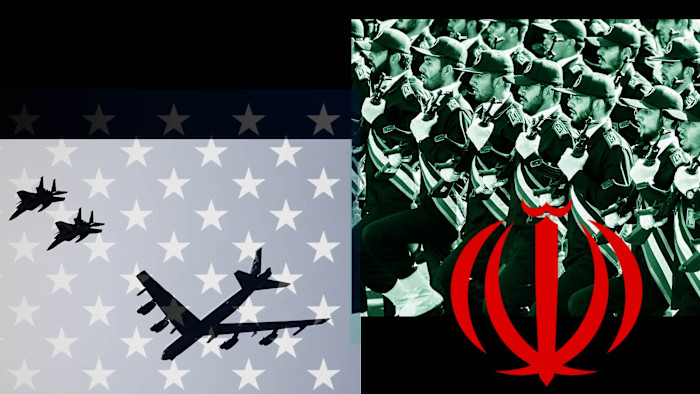
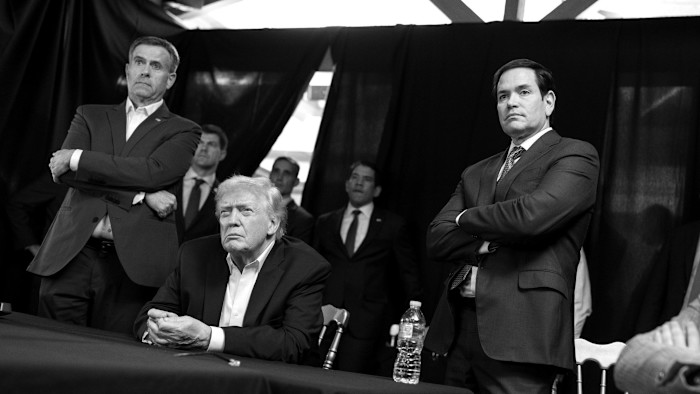
Donald Trump launched America’s new war against Iran from his Mar-a-Lago resort in the middle of the Florida night, casting it as a decisive bid to tackle Tehran in a way no US president had done in almost half a century.
The “massive and ongoing operation”, Trump said in an eight-minute video on social media, was aimed at stopping “this very wicked, radical dictatorship from threatening America”.
He claimed the primary goal was to eliminate Iran’s capacity to develop a nuclear weapon and develop long-range missiles. But Trump piled on other aims as well: the annihilation of Iran’s Navy, the neutralisation of its regional proxies, and ultimately regime change.
With the US flag and presidential seal behind him, and the shadow of his white cap partially obscuring his face, Trump called on Iranians to topple their rulers — and acknowledged that some US troops might die in this effort.
“We may have casualties, that often happens in war, but we’re doing this not for now. We’re doing this for the future,” Trump said.
For the 79-year old president who campaigned heavily on ending US involvement in “endless wars” and has been sceptical of American nation-building aspirations for years, the conflict he unleashed on Saturday marks his most risky military gambit yet.
The White House calculation is that Trump can unseat the Tehran regime without further destabilising the Middle East, or leading to deeper US involvement, such as troops on the ground in Iran, or retaliation against American interests in the region.
But it also reflects his own growing willingness to launch deadly military operations around the world, from Yemen to Nigeria, Syria and most recently Venezuela, and in international waters against alleged drug boats in the Eastern Pacific and Caribbean.
In recent months, Trump has made increasingly bellicose threats against Colombia and Mexico, and floated a military takeover of Greenland from Denmark, a Nato ally, before backing down after a massive European backlash.
Trump has also called for a 50 per cent increase in the $1tn annual US defence budget, while bragging of the many foreign interventions over his two presidential terms thus far.
“I will make peace wherever I can, but I will never hesitate to confront threats to America wherever we must,” Trump said during his State of the Union address to Congress on Tuesday night, as he pre-emptively justified a possible attack on Iran by accusing Tehran of harbouring “sinister” nuclear ambitions.
With the attack, Trump hopes to realise a long-harboured strategic goal of the US across multiple administrations. Since the 1979 revolution, presidents have tried different tactics to rein in the Islamic republic, from multiple rounds of sanctions, to George W. Bush’s branding Tehran as part of an “axis of evil”, to Barack Obama’s nuclear pact, which Trump tore-up during his first term.
In attacking Iran, Trump was emboldened by the more limited US strikes against the country’s nuclear facilities in June last year which did not trigger the broader regional conflagration that many feared. But this is a far bigger assault and the Islamic regime, facing an existential threat, was swift to fire missiles at US bases in Bahrain, Qatar, the United Arab Emirates, Jordan and Kuwait.

By the beginning of January, Trump was tempted to intervene again in support of sweeping protests on the streets of Tehran. “We are locked and loaded and ready to go,” Trump wrote on Truth Social, early on January 2, the day US special operations raided Venezuela to capture strongman leader Nicolás Maduro.
Trump at that point hesitated to strike, preferring to bolster America’s military capacity in the region with two aircraft carriers and dozens of planes and warships and make other attempts at diplomacy. He also faced pressure from US allies in the Gulf and Europe, who called for restraint.
But on Friday, as he made a visit to Texas on his way to Florida, with the Omani foreign minister back in Washington for a last-ditch push to find a diplomatic solution, Trump signalled he had lost patience. “I’d rather do it the peaceful way but they are very difficult people . . . dangerous people,” he said of Iran.
There is domestic political risk for Trump in the new Iranian attack. For one, disruption to global energy markets could raise US petrol prices as the country nears midterm elections. “A limited set of strikes could plausibly send oil towards $80 a barrel, while a longer conflict that causes disruptions to supply could send prices much higher — with a material effect on global inflation,” said William Jackson of Capital Economics, in a note on Saturday.

Parts of Trump’s Maga base have balked at his military adventurism on the grounds that it betrays his vow to avoid new conflicts and distracts the White House from tackling domestic concerns such as the high cost of living. The trauma of the ill-fated, costly, and prolonged US wars in Iraq and Afghanistan is still felt across the political spectrum.
“By attacking Iran, President Trump is risking the lives of US service members for an unnecessary war under the false notion that a country as weak and remote as Iran, which cannot strike the American homeland, posed an imminent threat to the United States,” said Rosemary Kelanic, director of the Middle East Program at Defense Priorities, a Washington think-tank, early on Saturday.
A poll released last month by Quinnipiac University found that 70 per cent of Americans did not believe the US should be involved in using the military to help Iranian protesters. Just 18 per cent backed strikes. According to the same poll, a strong majority of Americans said Trump needed to secure congressional approval before launching military operations against another country. Trump did not do so.
Speaking to the Washington Post this week, the US vice-president JD Vance, who is known for being sceptical of military interventionism, brushed aside some of those concerns.
“I do think we have to avoid repeating the mistakes of the past. I also think that we have to avoid overlearning the lessons of the past,” Vance said. “Just because one president screwed up a military conflict doesn’t mean we can never engage in military conflict again.”