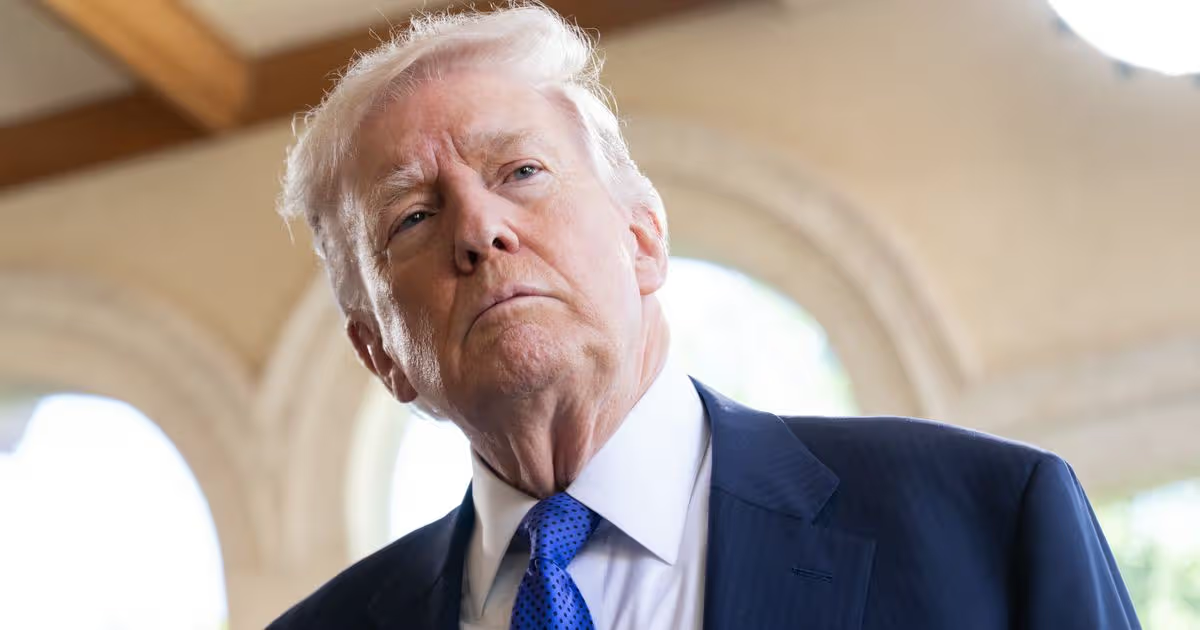
US President Donald Trump has ramped up the lethal war-machine armada parked off Iran by sending the most potent and largest carrier strike force ever built to Middle East
The United States is piling further pressure on Iran by sending a second aircraft carrier strike force to the Middle East – and this time it is the world ’s largest warship.
US President Donald Trump has ordered the USS Gerald R Ford to get underway from the Caribbean and back-up colleagues from the USS Abraham Lincoln. It more than doubles the firepower of the war-machine parked off Iran in the Arabian Sea and comes as tension mounts in the region over Tehran’s weapons.
The Ford is the largest warship ever built and is bristling with 90 of the world’s deadliest F-35C and Super Hornet fighters, helicopters and other killer weaponry.
READ MORE: Iran security widens cruel clampdown as it turns on reformistsREAD MORE: Chilling ‘five to midnight’ war warning to Iran amid troops build-up
It also boasts a number of high-tech Boeing EA-18G Growler electro-jamming planes which can render radar and weapons systems useless before a sea-to-air attack. The 100,000 tonne Ford is nuclear-powered and has an unlimited range, boasts an electro-magnet launch system for planes and is armed with Sea Sparrow missiles.
And it will take with it at least three Arleigh-class guided missile armed destroyers which will add extra lethal power to the carrier strike force already in the Arabian Sea. It’s F-35C Lightning II warplanes, like the ones carried by USS Abraham Lincoln, which reach speeds of up to Mach 1.6 at stealth, meaning they can slip past Iranian air defences.
If war breaks out they will be joined in waves by F-22 Raptors, already parked and ready to fight in Middle East bases, along with the carrier fleet’s Super Hornet jets. The entire fleet will be protected by a total of around nine destroyers once in position with the Lincoln, ready to fight off missile and drone attacks from Tehran.
It hugely boosts US potency as Tehran comes under pressure to ditch its nuclear ambitions, although it is not known exactly how long it will take for the carrier to get to the region. It was announced amid more sabre rattling from Iran. Ali Shamkhani, a top advisor to Iranian Supreme Leader Ali Khamenei, said:
“The level of military readiness is high, and the cost of any miscalculation for any party will be severe.” Another round of talks is planned as sides try to avoid a conflict spreading into the wider region and Israel prepares to defend against an Iranian ballistic onslaught.
The Ford was in the Caribbean as part of the recent Venezuela operation to unseat Nicolas Maduro and place him under arrest. Trump has warned Iran that failure to reach a deal with his administration would be “very traumatic.” He wants primarily to force Iran to reduce its enriched uranium stocks, reduce its ballistic weapons programme and deplete it proxy forces in the region.
Though Iran has agreed to talk about its nuclear programme it is unmoving on the ballistic weapons issue – a red line for Tehran which has flatly refused. Iran has denied thousands of executions have taken place inside the country during bloody protests and signalled it may climb down on its nuclear stocks.
It means it could reduce its stock of uranium from 60 per cent enrichment to 20 – whilst trying to leverage a relaxing of US sanctions in a bid to rescue its economy. But Trump has come under pressure from Israeli PM Netanyahu to insist Tehran reduces its ballistic missile programme – something Iran has refused to do.
Netanyahu has returned to Israel after a meeting with Trump in Washington and he said: “I will not hide from you that I expressed general skepticism regarding the quality of any agreement with Iran. However, I said that if an agreement is indeed reached, it must include the elements that are very important to us, from Israel’s perspective, and in my opinion not only for Israel.
“It is not only the nuclear issue — it is also the ballistic missiles and the Iranian proxies. That essentially summarizes the conversation, I would say, although it naturally also touched on Gaza, the broader region, and other general matters. In any case, another conversation with a tremendous friend of the State of Israel, the likes of whom we have not had before.”