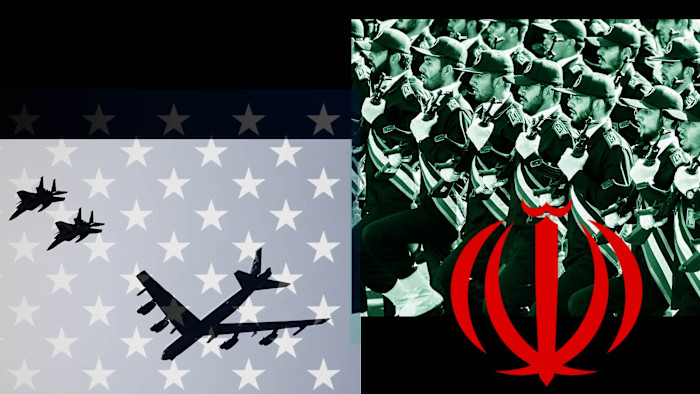
On Saturday morning, explosions rang out around Iran, with smoke rising over Tehran, while sirens wailed over Tel Aviv and Jerusalem.
Israel had begun a war against Iran, the defence minister Israel Katz announced, with Israelis calling it Operation Roar of the Lion. Israelis were told to brace for incoming Iranian missiles.
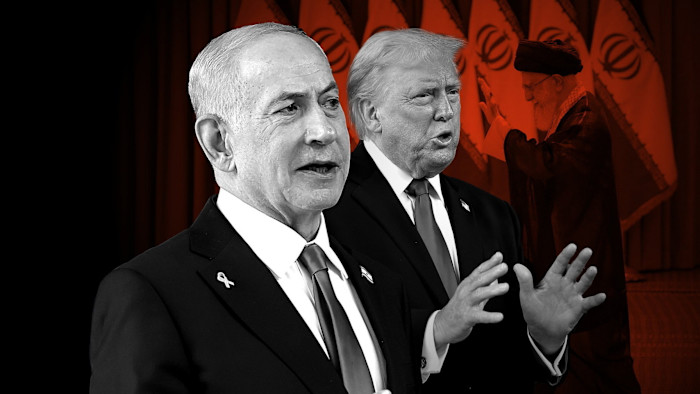
The US called it a “massive and ongoing” military operation against Iran, branding the effort Operation Epic Fury. “This regime will soon learn that no one should challenge the strength and might of the United States Armed Forces,” President Donald Trump said in a social media post.
What did Israel and the US strike?
Information on where Israel and the US had struck inside Tehran remained limited and internet access between Iran and the outside world was quickly curbed.
Early reports indicated strikes around Pasteur Street in Tehran, near the Presidential Administration of Iran. Iranian news agencies also reported explosions in other cities.
Those included Isfahan, where strikes were reported near the site of a nuclear complex that both the US and Israel struck last year during the 12-day war; Kermanshah, in north-western Iran, home to an Islamic Revolutionary Guard Corps base; and Shiraz, where the Israelis have alleged Iran has a large underground missile production facility.
Most of the dozens of reported strikes on Iran on Saturday took place before 1pm Tehran time, according to LiveUA data.
Trump said that Washington’s objectives were to keep Iran from building a nuclear weapon and destroy its ability to make long-range missiles that could hit the US.
But he also called on the Iranian people to “take over your government” once the strikes had ended.
Earlier on Saturday, Israel’s northern command carried out several strikes in southern Lebanon, hitting what it described as Hizbollah infrastructure.
Israel had been warning Hizbollah, the Iran-backed Lebanese Shia militant group, not to rush to Iran’s defence in preparation for just this eventuality.
What military assets does the US have?
The US has about 40,000 troops in the region, spread across bases and ships, and it has built up its largest naval force in the region since the start of its 2003 invasion of Iraq.
Washington’s newest and largest aircraft carrier the USS Gerald R Ford was in the Mediterranean this week, with reported sightings off the northern coast of Israel on Friday, while the USS Abraham Lincoln aircraft carrier strike group was already off the coast of Oman in February.
Each of the two strike groups is made up of one carrier and three guided-missile destroyers, with an array of weapons to attack and defend its own troops, as well as partner countries.
On board the USS Abraham Lincoln and USS Gerald R Ford are dozens of planes and helicopters, including F-18s, E-2 airborne early warning aircraft and cargo planes. The Gerald R Ford is also carrying F-35 jets. In addition, the US has dispatched planes to bases in the region.
The US has deployed additional Terminal High-Altitude Area Defense (THAAD) and Patriot air-defence systems. Both were used in the 2025 war and earlier assaults, depleting their stockpiles of interceptors.
The US operates eight permanent bases in the Middle East, in Bahrain, Kuwait, Qatar and the United Arab Emirates. It also has access to about a dozen other military sites, including in Egypt, Iraq, Jordan, Oman, Saudi Arabia and Syria.
The biggest is Al Udeid Air Base in Qatar — the headquarters for US Central Command, which is responsible for military operations throughout the Middle East. The base has about 10,000 troops. In June, Iran fired missiles at Al Udeid in retaliation for the US bombing the republic’s three main nuclear facilities.

How is Iran responding?
Iran’s elite Revolutionary Guards force said on Saturday that it had hit US bases in Bahrain, Qatar and the United Arab Emirates “hard”, as well as “military and security centres” in Israel.
“Missile and drone attacks by the Islamic Republic of Iran’s armed forces will continue,” it added.
Verified footage posted on social media showed a huge explosion at the US Navy’s Fifth Fleet base in Juffair, Bahrain, which serves as the headquarters of US naval operations in the Middle East.
Qatar said it had “intercepted and neutralised” three waves of Iranian missile attacks targeting several areas across the country, while Jordan said it had intercepted two ballistic missiles.
Saudi Arabia said Iran had targeted its capital, Riyadh, and its oil-rich eastern province. Kuwait said a drone struck its international airport, causing limited damage.
Israel declared a state of emergency, shutting its airspace as well as most workplaces and businesses and restricting gatherings. Iran launched a series of salvos against Israel, but air defences were able to intercept most of the missiles, though missile fragments and shrapnel from the interceptions caused small numbers of injuries.
The US has Thaad batteries and other defences positioned to protect Israel, alongside Israel’s own defensive systems.
Alongside its medium- to long-range missiles capable of hitting Israel, Iran also has a far greater number of short-range ballistic and cruise missiles that are able to strike US bases and naval assets.
When the US struck Iran in June last year, Tehran’s response was swift, but was choreographed with Washington to avoid escalation. Air defences shot down Iranian missiles aimed at Al Udeid, which had been emptied.

During two conflicts with Israel in 2024 and 2025, Iran fired hundreds of long-range ballistic missiles, slow-moving cruise missiles and drones. Most were shot down, but dozens broke through Israel’s multi-layered aerial defences and hit or landed close to sensitive military targets, including near the Mossad headquarters.
Iran has learned how to fine-tune the tempo and timing of salvos to maximise their effectiveness. The US and Israel’s stockpiles of interceptor rockets are, meanwhile, at unprecedented lows, adding to the risks of this conflict for them.
But firing those missiles also reveals the location of their launchers. The Israeli military has previously attacked launch sites immediately after the missiles are fired, a tactic it calls “killing the archer”.

Will the conflict expand?
Tehran has been replenishing its missile arsenal since June last year, after expending more than 500 during its brief war with Israel. Experts estimate the combined missile stocks to be in the thousands, capable of an extended salvo war.
Mining the Strait of Hormuz, a crucial shipping lane for global energy supplies from the Gulf, is another option for retaliation. But one expert cautioned this would spark a backlash from China, which depends heavily on Gulf oil.
Some ships turned back from the strait on Saturday, with one saying it had received a radio warning, allegedly from Iran’s Revolutionary Guard Corps, that the waterway was now closed.

Gulf states also fear Iran could attack energy infrastructure. In 2019, Iran was blamed for an attack in Saudi Arabia that temporarily knocked out half the kingdom’s crude output.
Iran could harass or seize nearby individual tankers as it did in 2019, or direct allied militias to attack regional energy infrastructure, analysts said. These regional proxies, such as the Houthis or Iraqi Shia militias, could also strike embassies or lightly defended bases.
As recently as November, Iran-backed groups were blamed for a rocket attack on the Khor Mor gasfield in Iraq’s Kurdistan region.
However, speaking before the attack, Jon Alterman of the Center for Strategic and International Studies in Washington said he expected retaliation to be calibrated. “Iran has never been interested in having an extended conventional war,” he said.
What are the implications for oil?
Oil markets will not reopen until Monday morning in Asia, but Brent crude rose as much as 3 per cent on Friday to touch a seven-month high of $73 a barrel.
The international oil benchmark has risen nearly 12 per cent over the past month as markets brace for potential supply disruptions from a US-Iran conflict. But it remains below the level of more than $80 briefly touched during the 12-day war in June.
Iran exports about 2 per cent of global oil supply, most of it to China. More importantly, it exerts influence over the Strait of Hormuz, through which about 30 per cent of the world’s seaborne oil trade passed last year.
The strait has never been closed, despite repeated threats from Tehran. Energy flows were not interrupted during last summer’s war with Israel. Even so, the surge in crude prices during that conflict underlined how sensitive markets are to perceived risks in the region.
Additional reporting by Najmeh Bozorgmehr, Simeon Kerr and Sam Joiner