Unlock the White House Watch newsletter for free
Your guide to what Trump’s second term means for Washington, business and the world
The US has significantly increased the number of fighter aircraft at bases in Jordan and Saudi Arabia this month, as it assembles tremendous air power in the Middle East for a potential weeks-long military campaign against Iran.
President Donald Trump has threatened to strike Iran unless the regime swiftly meets his demands for a deal aimed at curbing Tehran’s nuclear programme. On Thursday, he said the Islamic republic had a “maximum” of 15 days to reach a deal with the US or “bad things will happen”.
The air and naval deployments amount to one of the largest build-ups in the region since the 2003 invasion of Iraq.
Satellite imagery shows aircraft numbers have climbed this month at the Muwaffaq Salti Air Base in Jordan. A Tel Aviv University tracker estimates at least 66 fighter jets are at the base.
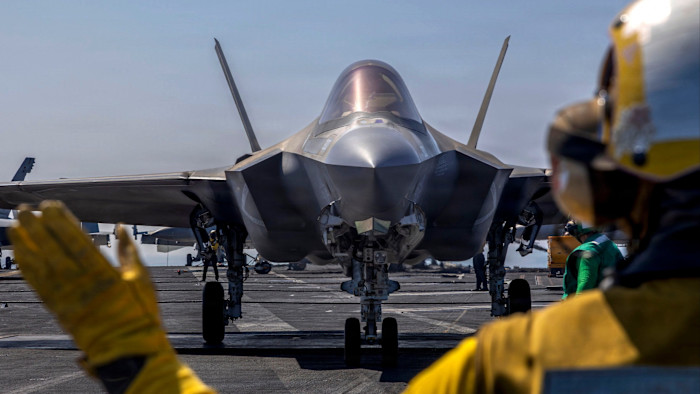
Eighteen of the jets visible in the imagery are F-35s — the world’s most advanced fighter jet — according to two former defence officials and an air force expert who reviewed the images. Also present are 17 F-15s and eight A-10s, the air force expert said.
EA-18 electronic warfare aircraft and cargo planes have also been spotted at Muwaffaq Salti by satellites.


The US position in Jordan was “instrumental” to kicking off and sustaining Washington’s invasion of Iraq in 2003, said Douglas Birkey, executive director of the Mitchell Institute for Aerospace Studies think-tank. The country has been “very permissive” in allowing US deployments for three decades, he said.
Satellite images also show an increase in jets at the Prince Sultan Air Base in Saudi Arabia. An air force expert identified E-3 airborne warning and control system planes and C-130 and C-5 transport aircraft there.

The US already had about five air wings — command units of around 70 aircraft — at bases in Jordan, Kuwait, Qatar, Saudi Arabia and the United Arab Emirates.
It has added two carrier air wings, on the USS Abraham Lincoln and USS Gerald R Ford aircraft carriers. Those units hold dozens of planes and helicopters, including F-18 fighter jets, EA-18 Growlers, E-2 airborne early warning aircraft and cargo planes. The Abraham Lincoln is also carrying F-35s.
There are 16 warships in total in Trump’s naval armada, plus two support ships. About 40,000 troops are deployed on bases and at sea in the region.
The naval fleet is the largest in the Middle East since five aircraft carrier strike groups were dispatched for the start of the 2003 invasion of Iraq, according to the Center of Strategic and International Studies think-tank. Of the 51 US naval ships conducting operations at sea, 18 — or 35 per cent — are in the Middle East.
“Most strikes would involve a combination of bombers and fighters to attack targets, suppress enemy defences and protect the aircraft strike packages,” said Birkey.
Bombers have longer ranges than fighters, can carry the largest bombs and in the case of the B-2, be stealthy. Fighter jets, which are more agile, can strike at high volumes but with smaller bombs and missiles.
Fighters can also act defensively. Last April, American F-15s shot down dozens of Iranian drones attacking Israel.

The decision to strike will depend heavily on Trump, said Birkey. “We need to be very careful with Iran, because if we do not engage” after such a build-up and threats, “it can embolden them to become more aggressive”, especially as the regime tries to rebuild from last year’s attacks by Israel and the US.
Trump on Friday said he was considering limited strikes to try to pressure Iran’s leadership into making a deal before any broader military campaign.
“They can’t just keep doing onesie-twosie-type strikes,” said Birkey. “Gradualism is a recipe for failure on so many levels . . . You’ve got to go to the mat,” in a geopolitical situation like this.
Abbas Araghchi, Iran’s foreign minister, told CBS on Sunday that Tehran was still working on a proposal for the US to consider and would “probably” submit it during potential talks with special envoy Steve Witkoff in Geneva, Switzerland, on Thursday.

“We are trying to make it something which consists of elements that can accommodate both sides’ concerns and interests,” Araghchi said, adding: “There is a good chance to have a diplomatic solution.”
The Iranian foreign minister said there was “no need for any military build-up”. He also warned that “we have to hit the American bases in the region” as retaliation for any strikes. The US military build-up “cannot help” bring about an agreement “and cannot pressurise us”, he added.
The White House did not immediately respond to a request for comment on a potential meeting between Witkoff and Araghchi in Geneva on Thursday.
As the possibility of an attack looms, the top US Air Force commander for the Middle East, Lieutenant General Derek France, pulled out of a warfare symposium in Colorado that begins on Monday.
Additional reporting by James Politi in Washington