Unlock the Editor’s Digest for free
Roula Khalaf, Editor of the FT, selects her favourite stories in this weekly newsletter.
Lebanese militant group Hizbollah is growing increasingly isolated after drawing the country into an unpopular war with Israel, with the backlash spilling over to the Shia community in heightened communal tensions.
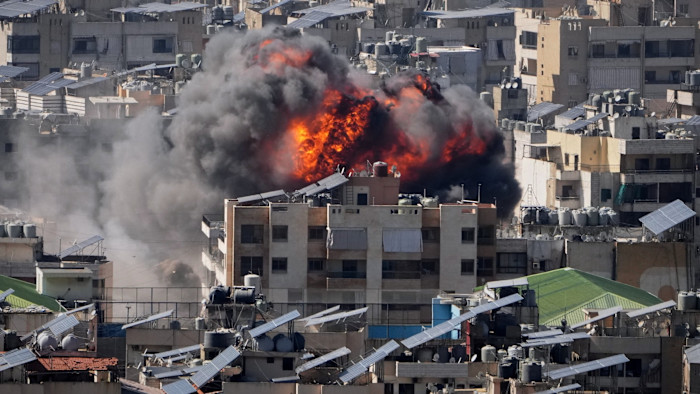
The Iran-backed Shia group fired a handful of rockets and drones at Israel last Sunday, triggering an Israeli offensive that has so far killed 634 people in Lebanon and displaced more than 800,000.
While Hizbollah maintains a strong base, the war has angered people across the country, which is still recovering from the devastation of the last full-blown conflict with Israel in 2024. Many critics see Hizbollah as fighting a war on behalf of Iran rather than Lebanon.
Hizbollah’s decision to join the conflict has sparked resentment towards the broader Shia community, beyond its hardcore followers, many of whom do not support the militant group.
Even its main political ally, the Shia Amal movement, opposed its involvement and voted in support of a ban on Hizbollah’s military activities last week — the state’s most aggressive move against the party, even if difficult to implement.
“The overall sectarian mood, other than the Shia, is very anti-Hizbollah,” said Imad Salamey, a political scientist at the Lebanese American University, adding that some Shia were against the war too.
Salamey said there were growing calls for stronger state action to disarm the militant group, even if that meant direct confrontation — something the state has tried hard to avoid.
One functionary in the powerful right-wing Christian party Lebanese Forces said Hizbollah and Iran “together drove the country into a war nobody wants or understands the purpose of”.
Israel’s offensive has forced hundreds of thousands of people — many of them Shia — to take refuge in largely non-Shia areas, stoking fears that the bitterness towards Hizbollah could boil over towards the displaced.
Lebanon has a bitter history of civil war, with sectarian divisions baked into its political system.
“This tension is now growing,” Salamey said. “If this conflict drags on and displaced communities continue to exert pressure . . . on the host communities that are primarily Sunni and Christian or Druze, the situation may soon get out of hand.”
The Amal movement, allied to Hizbollah, had been pressuring the group not to join the war, according to three people familiar with the party’s thinking.
Its leader Nabih Berri had received continuous assurances from Hizbollah that it would not involve Lebanon in the fighting up to a day before the first rockets were fired, and Berri was caught off guard by the attack, the people said. But they played down any wider rift.
Michael Young of the Carnegie Center in Beirut said that Amal’s support for the ban on Hizbollah’s military activities pointed to greater isolation. “But let’s not overestimate . . . Berri is not going to break with Hizbollah, he has no interest in creating a rift within the Shia community.”
The government has also increased its criticism of Hizbollah as Israel pressures it to do more to disarm the group.
Israel’s ambassador to the UN on Wednesday called for the Lebanese government to ‘‘mobilize its army and confront the terrorist threat Hizbollah poses’’.
On Monday, President Joseph Aoun accused those who launched the missiles — a reference to Hizbollah — of seeking to destroy the Lebanese state.
The backlash has deepened sectarian divisions.
“The Shia are going through their most difficult moments since [Israel] was created,” said Nassib Huteit, an academic close to Hizbollah. “They are waging an existential war, because there is no group that has not betrayed it: the Israelis, the [Sunni] extremists, and most of the Lebanese.”
He said displaced people had been killed in their homes by Israeli strikes after returning following humiliating rejections by host communities.
While many Shia have expressed exhaustion, Hizbollah can still call on deep wells of support, with many of its followers hardening their stance in the last two years.
There is also little faith in the state, which was unable to stop Israeli attacks that continued despite the US-brokered ceasefire that ended the last conflict in 2024. Lebanon has struggled to begin reconstruction.
In a displacement shelter in Beirut, an elderly man named Hussein Mousa explained how he thought supporters of Hizbollah were misunderstood: “They say we’re a foolish, crazy base, but we’re the supporters of resistance. And resistance needs to pay, to sacrifice’’.
Additional reporting by Raya Jalabi in Beirut