Unlock the Editor’s Digest for free
Roula Khalaf, Editor of the FT, selects her favourite stories in this weekly newsletter.
Hedge funds that had piled into emerging market stocks are rushing to reassess their positions as the US and Israel’s attack on Iran sends shares and currencies in some developing countries sliding.
MSCI’s broad EM equities index slid almost 2 per cent on Monday as shares in markets including Turkey and India came under pressure. JPMorgan’s EM currency index slid 0.7 per cent.
It marked a turnaround for EM equities, which were up 14 per cent this year as of Friday’s close, as the dollar’s decline lowered developing countries’ dollar debts and the cost of their imports. Low oil prices also provided a boost for countries that rely heavily on energy imports.
But the attacks on Iran risk upsetting those trends. The dollar has strengthened as investors have sought out haven assets, and the price of Brent crude jumped about 6 per cent. Asian and European gas prices also surged.
“I think the EM trade is a big risk now,” an executive at a large macro hedge fund told the FT.
“There is a lot of leverage in the system. [Funds betting on gains] in EM equities and fixed income have been a very easy one-way trade and I think it will be hugely challenged. It will have implications for the whole hedge fund community,” the person added.
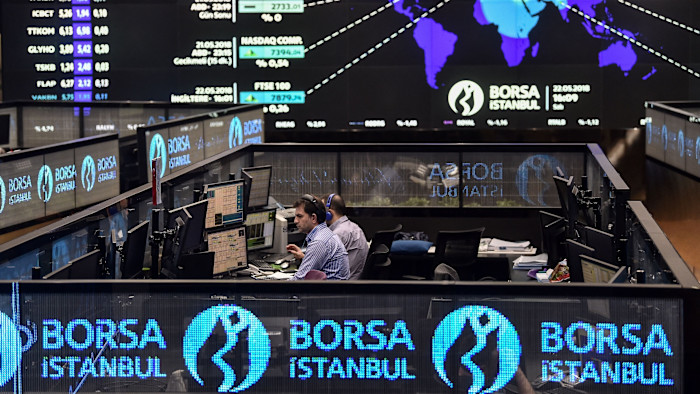
India’s Nifty 50 index fell 1.2 per cent on Monday, while Hong Kong’s Hang Seng declined 2.1 per cent and Taiwan’s Taiex lost 0.9 per cent. Turkey’s Bist 100 gauge slid 2.7 per cent.
Goldman Sachs’ latest prime brokerage report, covering the week to last Thursday, showed hedge fund allocations to EM stocks, as a proportion of their total exposure, were “hovering near five-year highs”.
Betting on EMs was among the most favoured trades for the week on a dollar-value basis, with stocks in South Korea and Taiwan particularly popular, the report added.
Investors who have in recent months diversified away from Wall Street stocks amid concerns about AI disruption said the Iran conflict had thrown their plans into doubt.
“We are actively looking at our EM exposure” because of the high degree of oil imports in the emerging Asian economies, said Salman Ahmed, global head of macro at Fidelity International. The asset manager had been bullish on the asset class going into this year and built up an overweight position.
Others stressed that only an extended conflict in Iran would lead to a long-lasting sell-off for EM indices, which have also benefited from heavy inflows into chipmakers, including TSMC, Samsung and SK Hynix.
“If this becomes a prolonged conflict, the crowded emerging market trade is at risk. Everyone is piled into emerging markets. Most macro returns have come from being long emerging markets,” said a portfolio manager at a big macro fund.
Investors who have added to their EM positions in recent months “need the conflict to be over soon”, the person continued.
EM currencies that usually move in line with global risk assets declined on Monday. The Hungarian forint, South African rand and Brazilian real declined between 1 and 2 per cent against the dollar, so far a lesser hit than last year’s “liberation day” carnage in markets over Donald Trump’s tariffs.

The Turkish lira also traded flat against the dollar following steps by the central bank to relieve pressure on its currency. Indonesia’s central bank also signalled that it was ready to defend the rupiah.
For an oil-importing country such as Turkey, “it would be inflationary if prices stayed this high, or higher, for longer than a few weeks,” but the country had reserves to defend the lira, said Carlos de Sousa, a portfolio manager at Vontobel.
“The fundamental drivers of the good performance in emerging market fixed income are still there,” he added, with countries having spent years reducing their reliance on imports and foreign capital flows.
“Current account deficits are much lower than they were in the past . . . we also don’t see exuberance in positioning,” said de Sousa.
In the past year, hedge funds had piled back into the local debt markets of Egypt and Turkey in particular, after these countries offered double-digit interest rates to support weakened currencies. As conflict over Iran grew closer in recent weeks, some investors exited these trades, with foreign holdings of Egyptian debt falling by $2bn to $30bn according to Citigroup.
But others bought protection to stay in the trade on the bet that the conflict would not last. “In the last few days, there had been hedges put on in Turkey, Egypt and some of the more crowded positions in local markets,” including through credit default swaps and forward bets on currencies, one investor said.
There was no sign yet of “serious outflows” from EM trades as a whole, they added. “Things haven’t reached that panic event. It’s not that kind of liquidity event where those lines are cut and there’s a flight to safe havens. That is the really painful event for emerging markets historically, and we’re just not there yet.”
Additional reporting by Kate Duguid and Emily Herbert