Stay informed with free updates
Simply sign up to the European banks myFT Digest — delivered directly to your inbox.
Cross-border mergers between EU banks have hit their highest level since the 2008 financial crisis, as rising profits and share prices in the sector bring an end to a long period of sluggish dealmaking activity.
Several multibillion-euro bank mergers helped to propel the total value of cross-border European banking deals to €17bn last year, up from €3.4bn the previous year, according to data provided to the FT by Dealogic.
Policymakers have long been calling for more consolidation across the EU’s fragmented banking market, which executives say has been plagued by regulatory hurdles and political resistance, causing the sector to lose more ground to bigger US rivals.
While progress in removing red tape around pan-EU banking has been slow, there are signs that European banks are pressing ahead with deals to expand across borders in any case.
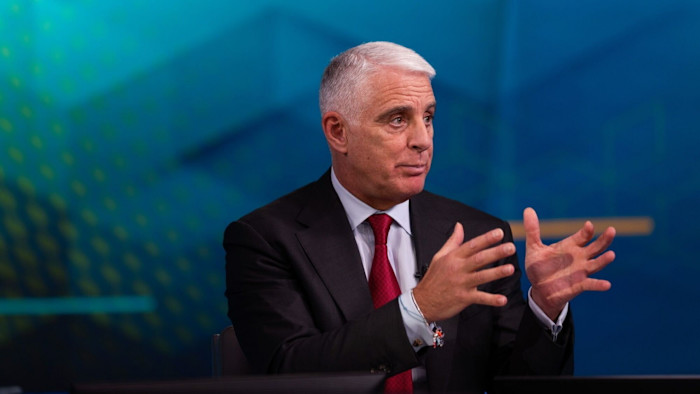
UniCredit chief Andrea Orcel, who has previously called for Europe to create larger and stronger banks to take on US peers, said last week “the competitive landscape is going to change dramatically,” citing new technologies and the rise of fintechs.
“I’m pretty convinced that there will be fewer banks [by 2030]. There will be winners and losers and the dispersion between winners and losers will be much, much greater. Some will consolidate. Some will be wiped out.”
Fernando de la Mora, co-head of financial services at Alvarez & Marsal, said the surge in EU banking deals was being driven by higher sector valuations, a stable macroeconomic environment, low default rates and the benefits of scale for large IT investments.
“In a stable macroeconomic environment, without credit risk issues and with high levels of technological transformation, the conditions for greater consolidation continue to be very favourable,” he said.
Spain’s Banco Santander’s €7bn sale of much of its Polish operations to Austria’s Erste Bank was one of the bigger deals that helped to push last year’s tally of cross-border consolidation to its highest level since €19.5bn of such deals were struck in 2008.
Other EU banking mergers last year included the €6.4bn acquisition of Portugal’s Novo Banco by France’s BPCE, which operates the Banque Populaire and Caisse d’Epargne banking networks, and the €1.8bn takeover of Germany’s OLB by France’s Crédit Mutuel.
The rise in EU banking mergers is part of a wider global trend. The value of worldwide bank mergers and acquisitions more than doubled last year to $190bn, according to a recent report by consultants McKinsey.
The number of EU cross-border banking mergers remained relatively low at only 19 last year.
Andrew Stimpson, head of European banks research at KBW, said there was momentum for more deals in 2026 and beyond.
“Now that banks are trading well above tangible book value, management teams need to assess how to deploy the large amounts of capital generated; buybacks can still make some sense, but organic growth and M&A are real options,” said Stimpson.
Hyder Jumabhoy, co-head of law firm White & Case’s financial institutions group, said the top 20 EU banks had amassed $600bn of excess capital over the past three years, which they are eager to deploy on deals. “This isn’t efficient,” he said. “Which is why you are seeing a pick-up in acquisitions both domestically and across borders.”
However, a senior executive at a large EU lender said there remained significant barriers to cross-border consolidation between the region’s biggest lenders.
The executive said takeovers of larger EU banks often trigger political opposition, such as the warnings directed by German political leaders to Italy’s UniCredit after it took a large stake in Commerzbank.
The banking executive said: “If we closed 100 per cent of the corporate centre and got rid of 20,000 to 30,000 people . . . is that something the government would accept?”
European bank executives complain that EU regulatory fragmentation traps hundreds of billions of euros in capital and liquidity behind national barriers. The ECB has estimated that €225bn of bank capital and €250bn of bank liquidity are immobilised by such national restrictions.
“Unless liquidity is fully fungible in Europe I am not going to buy another bank in a different country in the EU,” the executive said. “If JPMorgan has excess liquidity in Utah it is able to redeploy it to other parts of the US. But that is often not the case in Europe.”