Regime change, a campaign to stop Tehran’s ballistic missile programme, help for protesters and retribution for the deaths of American soldiers. Donald Trump has cited several reasons for launching the US into another Middle Eastern war.
On Monday evening his secretary of state, Marco Rubio, had another: the US knew that Israel was poised to attack Iran, which would retaliate against the US.
“We knew that if we didn’t preemptively go after them before they launched those attacks, we would suffer higher casualties,” he told reporters in Congress. Republican House Speaker Mike Johnson later repeated the same claim.
It was the latest explanation of many in the course of just three days of a new war with Iran that is rapidly descending into a regional conflict.
Already, the conflict has destabilised oil markets and brought a vital shipping lane to a near standstill. Hundreds of Iranians have been killed so far, according to the Red Cross, and six Americans — with more US deaths likely, Trump said.
Yet even as the turmoil threatens to widen, Trump’s timeline and explanation for his decision to go to war have changed at a head-spinning pace.
As he announced the killing of Iran’s supreme leader on Sunday, Trump said the “heavy and pinpoint” bombing would continue “uninterrupted throughout the week”.
By Monday, the US president said the war — for which he has not sought congressional authorisation — could go much longer.
“Whatever it takes,” Trump said. “Right from the beginning, we projected four to five weeks, but we have capability to go far longer than that,” he told CNN. “We haven’t even started hitting them hard.”
In the White House’s East Room on Monday, Trump said the goals also included stopping Iran from supporting “terrorist proxy groups abroad”.
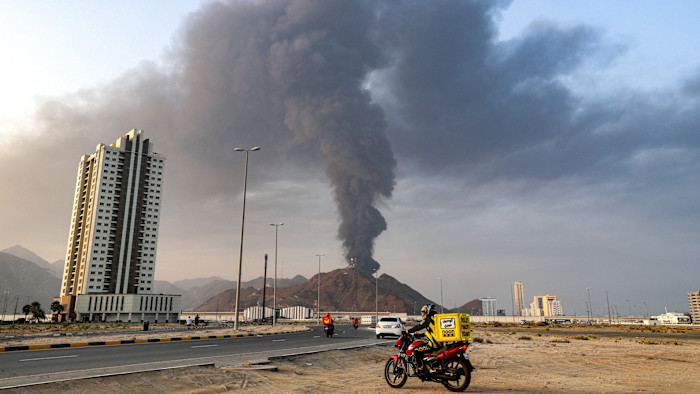
He was speaking after three US fighter jets had been downed by “friendly fire” over Kuwait, while Iranian retaliatory attacks had targeted cities such as Dubai and Gulf states’ energy infrastructure, sending oil prices sharply higher.
Since launching his war from Mar-a-Lago on Saturday, Trump’s stated aims have lurched from the overthrow of a “bloodthirsty” regime to forcing new talks with the same government — and everything in between.
On Sunday, in a six-minute video from his Florida estate, Trump framed the conflict as an epic cultural battle, accusing Iran of having “waged war against civilisation itself”.
It is Trump’s and Israel’s second attack on Iran in eight months. The US briefly joined Israel’s 12-day war last summer, when the US president claimed his military had “obliterated” Iran’s nuclear sites.
But the varied reasons for mounting an attack now have confused critics and allies.
The president had given “four different rationales for the war in the last 72 hours”, Democratic congressman Jake Auchincloss told the FT. With strategic clarity, US forces could “ruthlessly execute” their mission, he said, but added: “Who could take that kind of commander-in-chief seriously?”

Some contradictions have been explicit.
They started on Saturday at 2.30am, when Trump, sporting a white baseball cap, spoke by video to launch a regime-change operation, urging Iranians to “take over your government” and “seize control of your destiny”.
A day later, Trump’s surrogates said the administration had no interest in nation-building.
“That’s not our job, to pick the next Iranian government,” Republican Senator Lindsey Graham told NBC. “It’s not my job, it’s not President Trump’s job.”
Trump seemed to agree. In his Sunday message he said he had “fulfilled” his promise to help Iran’s people after the regime’s lethal crackdown last month. What comes next was “up to” them, he said.
But he also told The New York Times on Sunday that he had picked “three very good choices” among Iran’s officials to take over the country. A day later he told ABC that the US and Israeli strikes had been “so successful” the candidates were “all dead”.
“We don’t know who’s leading the country now. They don’t know who’s leading,” he told CNN.
The messaging whiplash from a president who vowed repeatedly to end the US’s “forever wars” has stirred anxiety in Washington.
“It’s like we’re going to break all the china and you guys decide how to put it back together,” Democratic Senator Tim Kaine said. “It seems like that is the strategy.”
Some people in Trump’s Maga constituency are worried.
This war was “going to uncork a significant can of worms and chaos and destruction in Iran now. Who takes over?” Erik Prince, who founded the Blackwater private security firm during the Iraq war, said on former Trump aide Steve Bannon’s podcast. “I don’t see how this is in keeping with the president’s Maga commitment.”
Maga influencer Matt Walsh spelt out his dismay on X: “So far we’ve heard that although we killed the whole Iranian regime, this was not a regime change war. And although we obliterated their nuclear program, we had to do this because of their nuclear program. And although Iran was not planning any attacks on the US, they also might have been.”
The Iranian people were now free, but the US also had “no idea” who would run the country, he wrote, adding that the messaging was “to put it mildly, confused”.
Rubio’s comments suggesting the US had been drawn into the conflict by Israel’s attack plans also drew incredulous reactions from Democrats.
“One country planning on attacking another country”— neither of which is the United States — “does not constitute an imminent threat”, said Democratic Senator Brian Schatz. “We are approaching Iraq war levels of deception from the Trump regime. It’s totally preposterous.”
The shifting justifications have echoes of the US attack on Venezuela, where Trump ordered special forces to capture strongman Nicolás Maduro in January.
After snatching Maduro, Trump vowed to “run” the Latin American country and considered putting troops on the ground to guarantee “peace, liberty and justice”.
Within 24 hours, his administration had anointed the dictator’s vice- president, Delcy Rodriguez, as the country’s new leader, leaving the regime otherwise intact.

Rubio was left to explain that sudden policy shift, too. Washington was seeking to dictate policy in Caracas, not occupy it, he suggested. The notion that Venezuelans would choose their leaders was replaced by the more pressing goal of US control of Venezuelan oil.
Ahead of the US-Israeli offensive — which Trump ordered from Air Force One en route to Texas on Friday — the president cited the Venezuela operation as a model. Analysts warned that Iran’s ideological and brutal regime was different from the government in Caracas.
“There’s something perplexing here in the theory of success, of how this is supposed to work,” said Kelly Grieco at the Stimson Center, a foreign affairs think-tank. “These people he identified as candidates” to run the country, “did they know they were candidates?”
Grieco said the plan had appeared to be “wishful thinking” without understanding how Iran’s regime worked. “There’s not good evidence historically that you can use air power to reshape domestic politics.”
The confusion, after just three days of war, has created space for others to project their own plan.
Reza Pahlavi, the exiled son of Iran’s last shah, declared just hours after the first strikes that he was “leading this transition” with the support of “millions”.
A rival exiled opposition group, the National Council of Resistance of Iran, also known as the Mujahideen-e-Khalq, has also declared its own provisional government.
“Operation Epic Fury is laser-focused,” said US defence secretary Pete Hegseth on Monday, in another attempt to explain the war aims. “Destroy Iranian offensive missiles, destroy Iranian missile production, destroy their navy and other security infrastructure, and they will never have nuclear weapons.”
The war would not be “endless”, Hegseth said.
Later, Rubio warned that Trump’s war was about to get even more severe. “The next phase will be even more punishing on Iran than it is right now,” he said.
Additional reporting by Lauren Fedor