
Limited supplies of critical defensive munitions to protect US forces and allies from Tehran’s missiles are set to shape any American military offensive against Iran, according to officials and analysts.
The US and Israel burned through their stockpiles of interceptors at an unprecedented rate during last year’s 12-day war, when Iran fired hundreds of missiles at Israel.
Now, the US military is weighing the likelihood that Iran’s retaliation will strain the supply of those crucial munitions while it struggles to replenish them, affecting not just the war in Ukraine but also Washington’s battle plans for any possible conflict with China or Russia.
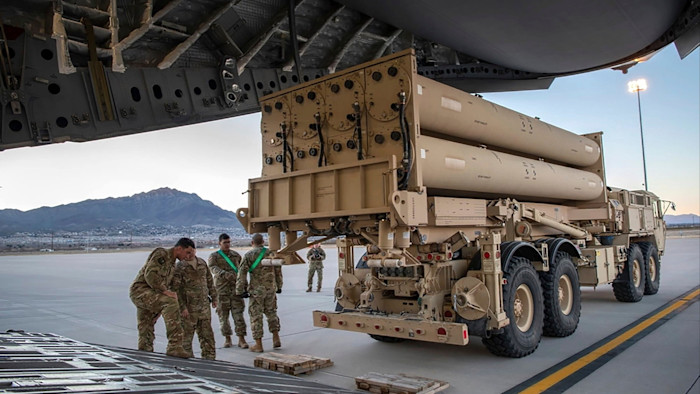
The “magazine depth” — military jargon for the stockpiles of available munitions — of the US’s Terminal High-Altitude Area Defense, or THAAD, anti-missile systems was of particular concern, said a regional military official.
The US fired as many as 150 THAAD munitions to defend Israel last year, they said. It has ordered fewer than 650 of them in total since the system went into operation around 2010.
Washington could “easily” expend a “whole year’s worth” of critical defensive munitions in just one or two days of operations “if Iran were able to launch multiple large salvos of missile and drone attacks” at US forces and Israel, said Stacie Pettyjohn, director of the defence programme at the Center for a New American Security think-tank.
The official said there was little likelihood that Iranian missiles would exhaust the US military’s defensive munitions during combat. But discussions have focused on the need to preserve those munitions for other theatres, which could force Israel to take more measures to protect itself while the US military shields its own forces and other allies, the official said.
US, French, British and other forces helped defend Israel from an April 2024 volley of hundreds of Iranian drones, cruise and ballistic missiles, fired in retaliation for the assassination of Iranian officials. But no such international coalition has been assembled for Israel’s defence this time around.
Iran and its regional proxy groups have used the so-called saturation method: overwhelming an enemy’s sophisticated aerial defences by firing massive barrages of relatively cheaper missiles simultaneously. That strategy has played into US planning for any offensive.
Both defensive and offensive “munitions would be a critical factor that the Pentagon would be highlighting as one of the potential costs of a conflict with Iran, especially if the president were thinking about a more sustained air campaign, and not just some limited punitive strikes,” said Pettyjohn.

During last year’s war the US navy also fired at least 80 sophisticated seaborne missiles, including one called the SM-3, which saw combat for the first time in April 2024 protecting Israel, the official said. It will procure only 12 SM-3s, which are optimised for ballistic missiles, this fiscal year for $445mn.
The Pentagon has said it will spend $840mn on 37 Thaad interceptors in the fiscal year 2026. The US army also requested $1.3bn for 96 defensive Patriot missiles this fiscal year.
Admiral James Kilby in June last year told Congressional leaders that the navy had burned through its interceptor missiles at an “alarming rate” during the 12-day war.
The navy had also used up roughly 200 SM-2 and SM-6 missiles by January 2025 during its campaign against Houthi militants targeting shipping in the Red Sea, according to a speech by Vice Admiral Brendan McLane, head of naval surface forces, at a conference last year.
That engagement also underscored a challenge for the naval destroyers currently deployed near Iran: the ships need to return to port in order to reload their magazines of missiles, and cannot reload at sea.
Any “air campaign right now is going to be fundamentally governed by our magazine depth”, which has “been taxed significantly supporting a variety of operations around the world,” said Doug Birkey, executive director of the Mitchell Institute for Aerospace Studies think-tank.
Israel’s own stock of interceptors is classified information, but their limited supply has been a concern for its military as Iran and Tehran-backed Lebanese group Hizbollah manufactured thousands of missiles over the past decade.
During the 12-day war, Iran fired more than 500 missiles at Israel. About 35 managed to pierce Israel’s multi-layered aerial defences.
The military official said the US and Israel had since conducted “autopsies” to determine if their limited stock of defensive munitions had been used efficiently. They looked at the possibility that both militaries had in some cases attacked the same incoming target.
Offensive munitions would also be a limiting factor, analysts said. In any conflict the US would be expected to fire Tomahawk missiles to avoid flying non-stealthy fighter jets into Iranian airspace.
The US used Tomahawks — which are fired from destroyers and submarines — in its campaign against Houthi rebels and last year’s bombing of Iran. Tomahawks would also be needed in a conflict against Russia or China, said Pettyjohn.
The munitions production issue has stemmed from inconsistent so-called demand signals, or long-term commitments to buy them, from the Pentagon. Without multi-year contracts in hand, defence companies were not incentivised to boost production. The US is now seeking to “turbocharge” production of some key munitions by striking agreements with major US manufacturers.
The regional official said it was not impossible that Iran’s response to any US strike might be muted, or similar to the choreographed June 2025 assault on an American airbase in Qatar, after US President Donald Trump ordered air strikes on the Islamic republic’s three key nuclear facilities. But that was far from assured, the official warned.
The “judicious use” of missiles is crucial when it comes to conserving magazine depth, Vice Admiral Charles Cooper told senators during his confirmation hearings to head US Central Command, which includes the Middle East.
“We’ve gone from firing $2mn missiles at $100,000 drones to just recently firing $25,000 Vietnam-era modified rockets at these drones,” he said.
Illustration by Ian Bott