
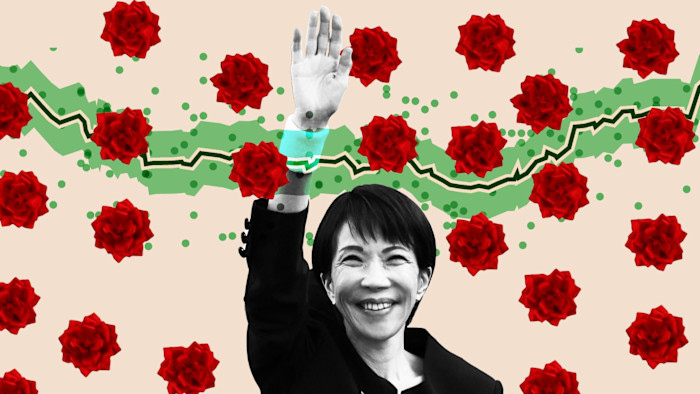
By 2.30pm on Saturday, five days into the shortest election campaign in postwar Japanese history and after half an hour of warm-up by the local Liberal Democratic Party candidate, the 3,000-strong crowd filling the Kanagawa Science Park finally got what it came for.
Sanae Takaichi, arch-conservative, populist and on course for a possible landslide this week, descended the spiral stairs to the stage to whoops, applause and bobbing ranks of mobile phones desperate to put it all on social media.
Japan’s first female prime minister, Takaichi receives personal scrutiny that her predecessors never faced during an election, especially over her appearance. Her choice of campaign trail footwear — almost immediately identified by netizens as a pair of 2020-era champagne-gold Mizuno walking shoes — draws particular admiration.
“Cool shoes! Girl power!” blurts the 49-year-old owner of a local clothing shop, delighted to have secured a spot near the front of the room along with both her mother, 81, and teenage daughter. The following day fans had produced a website with an AI manga of Takaichi to celebrate the shoes.
Elsewhere in the crowd, drawn mostly from local voters in the Tokyo-adjacent industrial city of Kawasaki, supporters flapped Japanese flags, portraits of Takaichi and a heart-shaped sign declaring adoration for a woman who has been in politics for three decades, but in the prime minister’s office for just three months.
The excitement around Takaichi is a domestic phenomenon, but the ramifications of Sunday’s elections will be global. Takaichi’s stint at Japan’s helm has already sent tremors through Japanese and US debt markets. An ongoing dispute between Japan and China looms over the most important trade relationship in Asia.
Takaichi’s surprise stardom has, for now at least, lifted some of the long-standing public despair over Japanese politics. Last summer, the collapse of the LDP seemed a real possibility. After ruling Japan for most of the past 80 years, the LDP appeared to be joining the other old mainstream parties in Europe and elsewhere that are disintegrating.
Since she became prime minister, Takaichi has buried those predictions under a spectacle of populism, novelty and contrast with what has come before. She may well triumph in Sunday’s election; less clear is how long Takaichi-fever survives its first post-ballot encounter with the cold realities of running a country whose currency is weak, whose public feels poor, and which is uniquely vulnerable to the collapsing global order.
On February 8, Japan will go to the polls for a snap election that almost no experts saw coming. Takaichi’s Saturday speech, which ranged from immigration, the weak yen and rising food prices to praise of Japan’s technology and work ethic, was a marker of unsettled, unhappy times. She hits the points of pain, say analysts, and then soothes with hope.
The delivery involves bluntness and a deliberate lack of nuance — an approach described by one audience member, a nurse in a retirement home, as “the things Japanese think but don’t say”.
Takaichi has criticised her own party’s lethargy, she has condemned the finance ministry’s parsimony over the nation’s purse strings and she has stressed the dangers of technology leakage to Japan’s enemies. She has worked out, says Japan Foresight analyst Tobias Harris, “how to fight an election with vibes rather than with detailed policy”.
Business leaders have told the FT they do not see her as a safe pair of hands, and many despair of the dispute with China that she triggered after just a few days in office with remarks about Japan’s potential military involvement in Taiwan. The yen has swerved violently during her short premiership and bond yields have lurched to record highs.

But for voters — if polls are to be believed — the strategy appears to be working. Based on the latest surveys, Sunday’s ballot stands to provide an unabashed nationalist, a fiscal dove and a devotee of Margaret Thatcher with the parliamentary firepower for potentially far-reaching change.
According to members of the PM’s close circle, Takaichi’s confidence and ambition have ballooned in recent weeks: she is no longer fighting merely for the LDP’s survival, but to put both herself and her party in a position of historic dominance. More dominant, even, than the position once commanded by her predecessor-mentor, the late Shinzo Abe.
“We knew she enjoyed strong support among working women, but what we saw in Kanagawa on Saturday was a support base broadening significantly,” says Tomohiko Taniguchi, a former speechwriter for Abe and chair of the ultra-conservative Nippon Kaigi lobby group. “People can sense her determination. Her strength, in the eyes of the voters, is that she doesn’t just want to win, but she wants to win big and decisively.”
Japan has a long history of political fads and shortlived fandom. They have historically been strongest in difficult times like the current mood. There remain significant doubts as to the true depth of public support behind Takaichi, and whether it will survive after her novelty wears off.
But analysts across the political spectrum increasingly acknowledge that the type of support on display in Kanagawa — cross-generational, middle class, actively enthusiastic for change and reaching for Takaichi as a symbol of something different and disruptive — is real. Just how deeply it has penetrated Japan’s rural constituencies, its industrial heartlands and its change-resistant centre holds the key to the huge bet she has placed on herself.
Takaichi’s prospects rest on her ability to maintain the faith of voters like Marie Enokido from Setagaya, who had hand-drawn an “I love Takaichi” fan for the occasion.
“I came here because I wanted to hear her voice,” says Enokido, who describes herself as a patriot. “My friends and I love her because she is a strong and wonderful woman and thinks properly about Japan without being swayed by other people.”
Takaichi became prime minister in October by winning an internal party race for the presidency of a beleaguered LDP, a party battered by two disastrous elections in as many years and currently without a majority in either house of the Japanese parliament.
The internal race, triggered by the resignation of Shigeru Ishiba, was Takaichi’s third attempt to secure the premiership. She has used those setbacks to her advantage, say analysts, presenting herself to a nation in need of inspiration as the Japanese model of endurance, determination and refusal to accept defeat.

In a few short months as PM, Takaichi’s approval ratings have ranged from about 57 per cent to as high as 82 per cent. She has doubled down on the image of female empowerment by appointing Satsuki Katayama, a formidable former Ministry of Finance bureaucrat, as Japan’s first female finance minister. Japanese media have amplified the sense of novelty. The latest edition of Eclat, a magazine aimed at Japanese women aged around 50, devotes a four-page spread to full examination of the enigmatic nature of Takaichi’s appeal, concluding that “fierceness and cuteness” are the driving forces.
Many academics also conclude that Takaichi has managed to capture Japanese imaginations after years of stultifying politics. Much has been made, in a political environment still rife with dynasties of MPs and elite families, of her middle-class, self-made background. Leaked stories of Takaichi’s refusal to accept the advice of bureaucrats, her long, solitary hours studying papers and her non-appearance at the dinners and drinking sessions that once defined political ascent within the LDP, have played surprisingly well with voters.
Yu Uchiyama, a political scientist at the University of Tokyo, says that while it is true that the PM’s brand of hardline conservatism is playing well in more inherently right-leaning times, the Takaichi phenomenon has a great deal to do with image.
“As the first female prime minister, many people instinctively think of her as something fresh. People have an expectation that Takaichi will change Japanese politics. People tend to like a strong leader, and she sounds bold and decisive,” says Uchiyama.
The election itself is now part of that image of decisiveness. On dissolving parliament last month, Takaichi said that she could not press ahead with her plans for Japan without a mandate from the whole nation; critics have speculated that she held the election to pre-empt a winter parliamentary session that would have quickly scythed through her popularity.
That risk may indeed have been rising, says Uchiyama, but other calculations will have been in play. The extremely short election campaign, he says, represented a big advantage for Takaichi. The whole field has not had time to prepare much, but the disarray within the main opposition bloc is more obvious and more hampering.

Analysts, including Uchiyama, see a number of ways in which the Takaichi bet may yet sputter. A low turnout could negate the apparent swell of support. The just-formed Centrist Reform Alliance, which includes the LDP’s former coalition partner, Komeito, could hit on a formula that successfully casts itself as the safe vote and Takaichi as dangerously right wing.
Ahead of the most recent polls, some saw vulnerability in the fact that Takaichi’s personal appeal is higher than that of the LDP, whose approval ratings sit at around 45 per cent. That is significantly higher than the 26.7 per cent the party achieved in the proportional representation result in the 2024 general election, but, say analysts, potentially more fragile than Takaichi’s personal popularity.
There have been at least two glaring mis-steps in the campaign so far, say analysts, both stemming from what her critics see as Takaichi’s tendency to speak without consultation with bureaucratic experts, or with a full assessment of the consequences. The first of these, even before campaigning began, was to pledge a two-year suspension of the 8 per cent consumption tax applied to food, which she has not mentioned in her stump speeches after it proved to be unpopular.
The second mis-step was to tell an audience that “nobody knows whether a strong yen is good or bad, or whether a weak yen is good or bad” — a comment made just days after her own administration had adopted the strongest possible terms to warn the market of its preparedness to intervene in markets to support the weak yen. When the yen duly began weakening on Monday, Takaichi posted on social media that her remarks had been “misunderstood”.
Despite these gaffes, several polls published since the start of campaigning, including one by the left-leaning Asahi newspaper on Monday, suggest that an outright majority for the LDP is now quite likely and that, in coalition with the Japan Innovation Party, she may secure at least 300 seats in the 465-seat lower house.

Crucially, says Japan Foresight’s Harris, the polls appear to point to a higher likely turnout than the 53.8 per cent at the October 2024 general election, where the LDP and its then coalition partner lost their combined majority.
Takaichi’s success, he argues, depends in part on her ability to inspire younger voters to break with their tradition of relatively low electoral participation. She also needs to draw back to the LDP the significant portion of conservatives who deserted the party at the last upper and lower house elections in favour of smaller rightwing parties like Sanseito.
“This all looks very possible now. A higher turnout will work in Takaichi’s favour,” says Harris. “She is looking at a bigger electorate, a younger electorate and an electorate that actively likes her.”
Mari Miura, a political scientist at Sophia University in Tokyo, says that Takaichi appears to be offering a model for Japanese women frustrated with an unfair society, while also bringing some hope to a wider Japanese public shouldering a broad range of dissatisfactions.
But the offer, says Miura, is shallow. Takaichi’s short time in office means the Japanese public has yet to see her being grilled in parliament and interrogated on the substance of her policies. In particular, the highly domestic focus of Takaichi’s populism has meant that she can run the campaign without the distraction of foreign policy.
As soon as the election is over, however, foreign policy will dominate, and her challenges will quickly pile up. Japan’s postwar history is defined by its relationship and military alliance with the US. Takaichi, in common with other US allies, faces a capricious US President Donald Trump.
But even on the domestic front, the dangers are everywhere. Takaichi’s reflationary rhetoric, for example, is at fundamental odds with the promises on helping households with inflation. Financial markets, since Takaichi became prime minister, have been on high alert for a “Liz Truss” moment, a reference to the former British prime minister, where pledges of government spending outstretch what the nation’s finances appear capable of bearing.
“I don’t think voters have had time to see what Takaichi really is, so she is gaining popularity for what they think she might be,” says Miura. “The danger is that there are a lot of problems and, if you listen to her actual policies, there is not a lot of content and not many good solutions. In that situation, politicians like Takaichi have given up on solutions and instead provide scapegoats.”

Prominent among those scapegoats has been foreigners, who now represent 3.2 per cent of Japan’s total population, in the face of deepening labour shortages in construction, farming and other labour-intensive industries. Rather than expressing outright hostility to immigration or tourism in principle or to foreigners in particular, Takaichi has channelled public concerns that the fabric of Japan is at risk from crime, a failure to appreciate Japanese customs, the purchase of cheap property and the exploitation of the weak yen. The LDP, she has said during campaigning, “will address the anxiety and sense of unfairness felt by the Japanese people”.
But a second, more striking target of scapegoating has been Japan’s own Ministry of Finance — an institution that Takaichi has blamed for damaging the country with austerity and for failing to encourage investment in the sort of industries Japan now needs to secure long-term economic growth. To many Japanese, and to many global investors eyeing Japan’s exceptionally high level of government borrowing, the MoF does not appear to have been a model of austerity.
Takaichi’s attack on the MoF is centred around a potentially major reform: a plan to scrap the now automatic supplementary budget, and return to issuing just a single annual budget. That discipline, she argues, will allow for longer-term investment, and will strip the MoF of a key lever of power over prime ministers like her who want to spend big.
More broadly, her approach has rattled markets, sending yields on Japanese government bonds sharply up. Since then she has fought a rearguard action, along with finance minister Katayama, to calm markets and convince them that Japan’s fiscal health is in good hands. But markets remain wary and traders are watching for any signs that is not the case.
For some analysts, the tensions between Takaichi and the bond market underline a deeper issue for the country and its central bank, which is trying to sustainably raise interest rates for the first time in decades.
“The JGB market is rational. It is the BoJ that is a bit irrational. They are the ones that don’t realise this is risky,” says Alicia García-Herrero, chief economist for the Asia-Pacific region at Natixis, arguing that the central bank should have moved quicker to increase borrowing costs as inflation rose.

Others believe that Takaichi is simply getting a crash course in how to communicate with financial markets — a particularly difficult task during a short, aggressive election campaign.
“Japan’s fiscal situation is not going to fall apart tomorrow, but signalling matters, and you need to be able to be on top of what’s going on in the JGB market,” says Naomi Fink, chief global strategist at Amova Asset Management. “You need to have a dialogue with the markets.”
Back in the Kanagawa Science Park, the nervousness of the bond market and the realities of politics in a fracturing world are swept aside by expert crowdwork. As the speeches draw to a close, a local LDP member leads 3,000 supporters in a chant of “hatarakuzo!” (“I will work!”) repeated five times in an echo of Takaichi’s first speech as prime minister.
Takaichi’s two great heroes, Thatcher and Abe, were notable for their prime ministerial longevities of 11 and eight years respectively; 15 of Japan’s prime ministers since 1990 have lasted less than two.
Her durability will rest partly on the sustained support of attendees at the rally who say they are more engaged in politics than they have been in years. One woman, a part-time piano teacher who gave her family name as Okawa says that “I don’t really know what is happening in the rest of Japan, but all my female friends here love Takaichi.”
She adds: “I’ve told my husband we have to keep her on as prime minister, so I hope lots of wives are saying the same thing to their husbands in other places.”
Data visualisation by Jonathan Vincent and Keith Fray