Unlock the Editor’s Digest for free
Roula Khalaf, Editor of the FT, selects her favourite stories in this weekly newsletter.
The influencer economy is based on the idea that if someone of status does a thing — a Kim Kardashian or a Hailey Bieber, say — others will flock to do it too. This seems to apply quite well to clothes, gadgets, make-up and hairstyles. But does it work with microchips? AMD is making a bet, potentially paid for in its own shares, that it does.
The chipmaker signed a deal with Facebook owner Meta Platforms on Monday that’s very like one it inked with OpenAI in October. AMD will sell its Instinct chips to Meta, furnishing data centres that use power equivalent to 6 gigawatts. To mark this as a “strategic partnership” rather than just — heaven forbid — a financial transaction, AMD is also giving Meta warrants that could convert into a 10 per cent stake in the company.
Getting much more business out of Mark Zuckerberg is clearly worth something to AMD. But how much, exactly? AI chip supremo Nvidia says it makes about $35bn per gigawatt supplying data centres; assume AMD, as the market’s second fiddle, makes $25bn. That’s $150bn of revenue over time. After expenses and tax, the Meta deal might bring $45bn of total earnings. In today’s money, that’s probably close to the $30bn increase in AMD’s market capitalisation after the tie-up was announced.
But warrants, which many tech companies have been handing out like sweets as they form AI-related alliances, have a cost. Meta can only cash them in if it buys the full quota of chips, and AMD’s share price roughly triples. But if all goes to plan, Meta’s stake would be worth just under $100bn. Discount that back five years, and assume a 50 per cent chance all milestones are reached, and AMD is giving Meta a $30bn loyalty bonus.
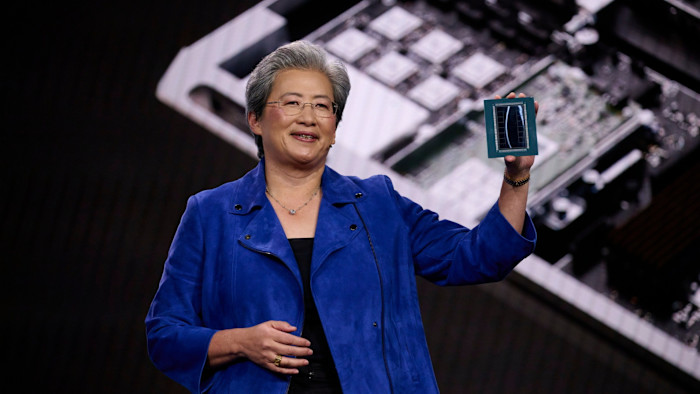
If Meta were to chips what George Clooney was to Nespresso, this would all make sense. Implicitly, AMD’s willingness to parcel out warrants assumes that if Meta and OpenAI place giant bets on its chips, so will other so-called hyperscalers such as X, Google and Amazon. That would indeed be helpful, because AMD chief Lisa Su has set out growth targets that require her to increase data centre revenue roughly tenfold by 2030.
But it’s hard to avoid drawing the inverse conclusion: AMD fears that if Meta doesn’t buy, other customers might not either. After all, if its Instinct chips are truly competitive, Meta should want them anyway — especially given the scarcity of AI silicon. Nvidia chief Jensen Huang says growth for his own market-leading chips is “skyrocketing”. His company has taken others’ stock, but not given away its own. In offering a sweet deal to the influencers, AMD is paying the price of being number two.
john.foley@ft.com