Unlock the Editor’s Digest for free
Roula Khalaf, Editor of the FT, selects her favourite stories in this weekly newsletter.
Marine Le Pen’s far-right party racked up gains in the first round of municipal elections across France on Sunday, in a sign of its growing appeal ahead of next year’s presidential election.
Voters in France’s 35,000 municipalities largely elect their mayors based on local issues and personalities, but this year’s ballot has become a key test of parties’ strategies, strengths and appetite for forming alliances before next year’s presidential election to succeed Emmanuel Macron.
For Le Pen and her Rassemblement National (National Rally) lieutenant Jordan Bardella, the first round showed progress on their strategy of expanding in the south to complement their traditional power base in the industrial north. In Marseille and Nice, candidates came in first or second, putting them in a strong position for the run-offs on March 22. RN candidates also did well in Perpignan and Toulon, where far-right parties have long been popular.
But the RN could still be beaten or outmanoeuvred by opponents forming second-round alliances, analysts said.
Ipsos-BVA pollster Mathieu Gallard said the party’s first-round results were “mixed” as strong scores in cities such as Nice were offset by weaker ones in midsized northern cities such as Lens. “The RN has progressed in many cities and continues to implant itself locally,” he added.
The Socialist party looks well placed to keep hold of Paris town hall after 25 years in power. Its candidate Emmanuel Grégoire finished comfortably first ahead of the conservative candidate Rachida Dati.
But three other candidates made the run-off, complicating the race and leading to much horse-trading ahead of the second round. Centrist Jean-Yves Bournazel, far-left candidate Sophia Chikirou and far-right newcomer Sarah Knafo will sap momentum from the first two contenders unless they are able to form alliances — or some of the less popular candidates bow out.
Édouard Philippe, a former prime minister who was bidding for re-election in Le Havre, was ahead by about 10 points in the first round, upsetting some pollsters’ prediction that the centre-right politician’s presidential ambitions could be thwarted by a loss in the northern port city.
On the far left, Jean-Luc Mélenchon’s La France Insoumise (France Unbowed) party fielded hundreds of mayoral candidates for the first time, doing well in cities such as Lille and the northern Paris municipality of Saint-Denis. An LFI candidate in the northeastern city of Roubaix has a good chance of winning the run-off, in what would be the party’s first city above 100,000 residents.
Ahead of the second round next Sunday, candidates and parties will begin horse-trading over merging electoral lists or striking other deals to ensure victories or block opponents.
Leftwing leaders called for rival parties to team up to block the far right, a tactic known as the “republican front”, in another sign of how the 2027 contest is already shaping up as a showdown with the RN. LFI’s Manuel Bompard urged parties to form “an anti-fascist front”, while Socialist leader Olivier Faure lamented how the far right was “instilling its poison”.
Even if the RN does not win town halls outright, they are on track to return their highest-ever number of local councillors, an outcome that will help them gain ground in the Senate. The French parliament’s upper house will be elected by local officials in September. The RN currently only holds about a dozen mayoralties.
“I call on you to choose deeply patriotic mayors who will embody political change and national rebuilding,” said Bardella at an election night party. “Change will not wait until 2027.”
According to provisional first-round results, in the Mediterranean port city of Toulon, the RN’s Laure Lavalette finished first and will face two rightwing candidates in the run-off. In Perpignan, the biggest city now under RN control, incumbent mayor Louis Aliot was re-elected outright in the first round.
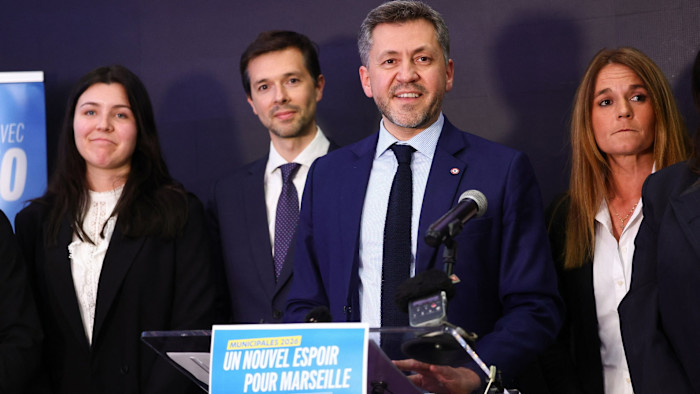
In Marseille, the RN’s Franck Allisio came in a close second to incumbent leftwing mayor Benoît Payan, setting up a potential four-way run-off, the outcome of which will depend largely on whether the far left swings behind Payan.
Eric Ciotti, who heads a far-right party allied with the RN, took pole position in Nice, France’s fifth-biggest city, winning 41 per cent.
“It is difficult to see a clear national trend so far, but next week’s headlines will be set by whether the RN can deliver final wins in Marseille, Nice or Toulon,” said Mujtaba Rahman, who leads Eurasia Group’s analysis on Europe. “If they fail, the results will be a setback for them.”