Unlock the White House Watch newsletter for free
Your guide to what Trump’s second term means for Washington, business and the world
The trouble with strongmen is that they can easily change their minds.
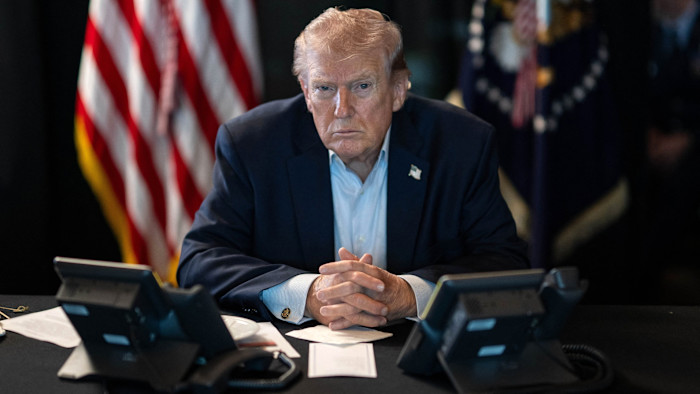
In his inaugural address last year, President Donald Trump promised to be a “peacemaker” who ended wars of choice. He is now embroiled against Iran in the mother of all regime changes. Perhaps ground realities will force him to drop that goal. Even his cabinet, not to mention Congress and US allies, however, are in the dark about what his exit plan looks like. As Trump told The New York Times in January, his sole restraint is “my own morality . . . It’s the only thing that can stop me.” America’s constitutional system has so far given no reason to doubt him. What happens in the widening theatre of war is another matter.
Leaving aside Israel’s opening strike, Trump’s moment of peak potency was choosing to go to war with Iran. From then on, Trump lost his monopoly on how the war unfolds. Many others — not just Iranians — now have a say over its direction.
Trump himself is in several minds about his aims. In the first 72 hours, he has variously said he wants to eliminate Iran’s nuclear weapons programme, end Iran’s ability to export terrorism, overthrow its regime or find a new leader inside it with whom he could do business. Most of Trump’s comments come in the form of telephone musings to reporters. To one he said the war could last another “four to five weeks”; to another, that he was ready to talk with Iran. But he also questioned whether there was anyone left to talk to.
His war aims are thus kaleidoscopic. Contrary to what Trump has said, the US and its allies faced no imminent attack from Iran. There is nothing that was pre-emptive about this war. Nor, as he also claimed, was Iran close to developing missiles that could reach America. His envoy, Steve Witkoff, was hyperbolic a few days earlier to say that Iran was “a week away from having industrial grade bomb-making material”. Oman’s mediators also dispute Trump’s claim that Iranian negotiators were refusing to bend. What Iran offered last week — zero stockpiling of low-grade enriched uranium — was better than what Barack Obama got in the 2015 nuclear deal from which Trump withdrew.
Deep scepticism is warranted over Trump’s ability to stop more slaughter on Iran’s streets. Though he is urging Iranians to rise up, they have no way of knowing that would not be suicidal. Regimes are not changed from the air. Trump could help only by invading their country. For the first time he is entertaining that idea. “I don’t have the yips [anxiety] with respect to boots on the ground,” he told the New York Post. At the same time, he is inviting Iran’s paramilitaries to hand over their weapons (“they would simply surrender to the people, if you think about it”). Perhaps they might disarm in a galaxy far, far away. On this planet, the fog of war starts in Trump’s mind.
Anyone who claims to know where this war will go, including Trump, is bluffing. Among the possible outcomes, however, peaceful transfer of power is one of the least likely. Iran’s regime has recently murdered thousands, perhaps tens of thousands, of its own people. What remains of the country’s top leadership has its back to the wall. Trump has conveyed to them that this war is existential. Yet he expressed surprise they are firing drones and missiles at the Gulf states that host US bases — an obvious escalation for Iran’s endangered theocracy to take.
That is why none of the Gulf monarchies wanted this war. Their place as linchpins of the global economy is now dangerously exposed. Trump did not listen to his Gulf friends. Nor did he pay heed to the risk scenarios laid out by General Dan Caine, chairman of the US joint chiefs of staff. A country Iran’s size cannot be transformed by remote control.
His bet was that Iran would quickly fold. So far, there is no sign of that. We are thus now moving into an endurance test. The longer Iran can sustain its Shahed drone attacks, the likelier they are to claim a significant toll of US and other lives. The war threatens to turn into a contest over which can hold up longer — Iran’s ability to produce drones versus America’s capacity to intercept them.
A prolonged conflict will also eat into American pocketbooks. Trump’s Maga supporters believed that he would mark a sharp break from the era of forever wars and squeezed incomes. They were mistaken. Trump has seen George W Bush’s record and raised it. There is nothing good to say about Iran’s regime. But it has shown a better instinct for reading Trump’s intentions than his voters.
edward.luce@ft.com