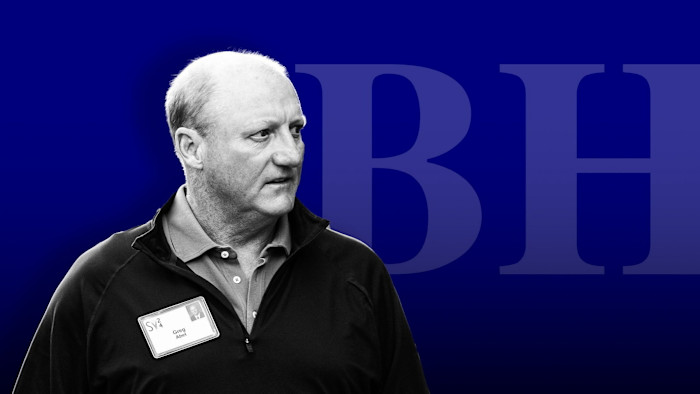
Berkshire Hathaway’s new chief executive Greg Abel on Saturday said that he was committed to retaining the $1.1tn conglomerate’s fortress-like balance sheet, and that its massive cash holdings did not signal a retreat from dealmaking.
Abel used his first letter to shareholders to underscore his investment bona fides and his commitment to the principles that predecessor Warren Buffett had long extolled.
Abel, who took over in January, cast himself as a steward of Buffett’s legacy and signalled that the company’s investment philosophy was not changing.
He told shareholders that Berkshire had been active in evaluating new investments and that it would remain a key port of call when companies wanted to sell. The Nebraska-based conglomerate would be “an asset, not a risk, to America and the global financial system”, he wrote.
“Our balance sheet is a strategic asset to be deployed at the right time,” he wrote. “It allows us to act decisively, invest when others are tentative or fearful, and stand firm when financial storms roll through.”
The 63-year-old said share repurchases would remain an “important capital allocation option” and the company would not pay a dividend so long as he and the board believed Berkshire could generate shareholder value with that capital.
Berkshire’s cash levels stood at $373bn at year-end, a record when excluding the value of Treasuries it had previously bought but had not yet paid for.
“Many times in Berkshire’s history, some observers have suggested that our substantial cash position signals a retreat from investing,” Abel wrote. “It does not.”
He pointed to Berkshire’s $9.7bn purchase of the chemicals business of Occidental Petroleum, which it completed earlier this year, as well as its agreement to buy pest control business Bell Laboratories.
“There will undoubtedly be incremental opportunities to deploy our owners’ capital without compromising Berkshire’s resilience,” Abel wrote. “My role is to ensure our liquidity levels and capital deployment remain intentional and deliberate.”
He added: “We will always aim for ownership of productive businesses over US Treasuries.”
Investors and analysts traditionally scour Berkshire’s annual letters for insights into how the so-called Oracle of Omaha saw the world. In the past they were filled with Buffett’s personal anecdotes. He also used the missive to highlight key Berkshire staff, including Abel, which shareholders saw as an indication of an individual’s star rising within the notoriously decentralised company.
Abel said that Buffett continued to come into the office five days a week and was “available to us”. But he has begun to reshape Berkshire’s corporate headquarters. The company last year hired its first internal legal counsel and announced a top executive from Berkshire’s energy business, the unit Abel rose up through, would become its next chief financial officer later this year.
One of Buffett’s investment deputies, Todd Combs, departed for JPMorgan Chase as part of the reshuffle. Abel noted that the stock portfolio Combs had built was now being partially overseen by the company’s investment manager Ted Weschler.
“At Berkshire, equity investments are fundamental to our capital allocation activities; responsibility ultimately resides with me as CEO,” he wrote.
The letter struck a less folksy tone than Buffett often did. Abel’s writing was straightforward, occasionally straying into corporate jargon, including when he detailed the push to improve railroad operator BNSF’s operating margins.
He continued Buffett’s tradition of using the letter to highlight mistakes and areas in which the dozens of businesses owned by Berkshire needed to improve. He also detailed the cash generation of many of the company’s subsidiaries, which touch vast parts of the US economy and financial system. Investors have in the past complained about the limited disclosure Berkshire provides on these units.
Macrae Sykes, a portfolio manager at Gabelli, which is invested in Berkshire, said the letter “showed humility, expressed clarity in communication and confidence in his role”.
“Technically a gold medal for annual letter review of corporate businesses,” Sykes said, noting Abel touched on all of Berkshire’s core businesses. “Shareholders should be convinced he has a comprehensive understanding” of the business, he said.
The letter accompanied fourth-quarter results that showed Berkshire’s operating earnings had weakened, falling 30 per cent from the year before to $10.2bn, as its insurance division’s profits slumped.
Net income fell 2.5 per cent from the year earlier to $19.2bn. For the full year, net profits were down 25 per cent to $67bn.
Echoing Buffett’s past remarks, Abel cautioned investors not to draw conclusions from the net figures, which are impacted by the rise and fall in value of its $298bn stock portfolio.
Abel said the results “underscored the durability of our operating businesses, while also reflecting the fact that we have opportunities for further improvement”.
He noted that Berkshire’s insurance businesses were experiencing intensifying competition as capital poured into the industry from private investment groups, which had weighed on pricing. Berkshire has traditionally cut back its underwriting activity when the insurance premiums it can earn are not attractive, a stance Abel said remained a core principle.
Berkshire also continued to sell off part of its equity portfolio, which includes multibillion-dollar stakes in companies like Apple and American Express. The company trimmed the portfolio by $3bn in the final three months of last year, taking its stock sales since it began disposing of positions in 2022 to $187bn.
Abel does not plan to provide quarterly earnings commentary, which Buffett has long eschewed. But he said he was keen for shareholders to get “to know, over time, more of the Berkshire team”.
He said he would be joined on stage at the company’s annual meeting in May by several top executives, including Ajit Jain, who runs Berkshire’s insurance operations, BNSF chief executive Katie Farmer and Adam Johnson, who was recently elevated to oversee the company’s consumer products, services and retailing units.
“Warren is obviously a very hard act to follow,” he wrote.