The US and Iran held indirect talks over Tehran’s nuclear programme on Thursday, aiming to avert US strikes on the Islamic republic after a warning from secretary of state Marco Rubio over its ballistic missiles.
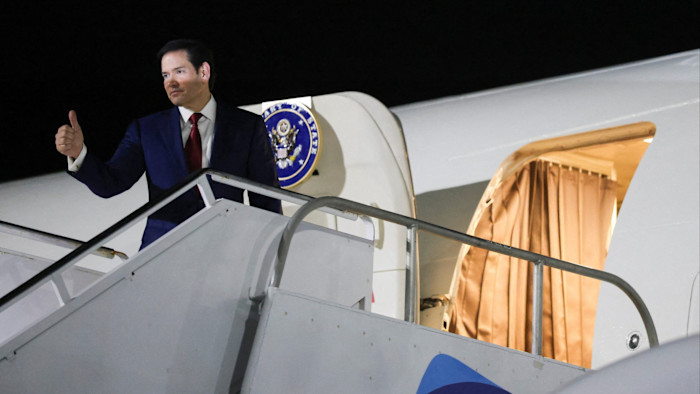
Speaking during a visit to the Caribbean island nation of Saint Kitts and Nevis on Wednesday, Rubio sought to bolster the justification for a possible armed intervention, a day after US President Donald Trump accused Tehran of harbouring “sinister” intentions on its nuclear programme.
Rubio said Tehran “refuses to talk about [its] ballistic missiles to us or to anyone, and that’s a big problem”.
The Islamic republic had “thousands of short-range ballistic missiles” that threatened US forces and its bases and partners in the region, America’s top diplomat said. Tehran also had naval assets that “threaten shipping and try to threaten the US Navy” and conventional weapons that were “designed to attack the US”, he added.
Rubio said Thursday’s talks in Geneva, involving US negotiators Steve Witkoff and Jared Kushner on the American side, would be “largely focused on the nuclear programme”, and that Washington hoped “progress can be made”.
Oman’s foreign minister Badr Albusaidi said on Thursday afternoon that the talks, which began in the morning, had adjourned for a break and would resume later in the day.
“We’ve been exchanging creative and positive ideas in Geneva today,” he said, adding on X that “we hope to make more progress”.
Rubio criticised Iran for “trying to get to the point where they ultimately can” enrich uranium, though he acknowledged that the country was not doing so yet.
“They don’t need to enrich in order to have nuclear energy. They don’t need nuclear energy, by the way, they have plenty of natural gas,” Rubio said.
“The fact that they insist, not just on enrichment, but on enrichment and locations located inside of mountains is . . . you would have to lack common sense to not know what that means, or what that could mean.”
Trump last year claimed to have “obliterated” Iran’s nuclear programme when the US briefly joined Israel’s 12-day war with the Islamic republic to target its atomic sites.
Iranian leaders insist their nuclear programme is solely for peaceful purposes and that any agreement must recognise what they describe as Iran’s right under the nuclear non-proliferation treaty to enrich uranium.
Tehran has also said it will not agree to separate US demands to restrict its ballistic missile programme or to curb its support for anti-Israel armed groups.
Experts have struggled to assess the size of Iran’s ballistic missile arsenal in the wake of the 12-day war last year. Iran fired more than 500 medium- to long-range missiles at Israel during the conflict, and many more were destroyed on the ground by Israeli air strikes.
They said it was plausible that Iran’s short-range ballistic missile arsenal is still in the thousands, however, as few were used in the war.
There has been an increasing drumbeat from Israeli government sources in local media in recent months warning that Iran was reconstituting its missile arsenal faster than anticipated.
Danny Citrinowicz, an Iran expert at the Institute for National Security Studies in Tel Aviv, said Tehran’s “missile architecture is the backbone of Iran’s deterrence strategy”.
“Iran’s security doctrine is fundamentally asymmetric,” Citrinowicz said. “At its core is an extensive missile and UAV [unmanned aerial vehicle] arsenal designed to compensate for conventional military weakness and to deter its primary adversaries, meaning the United States and Israel.”
Lynette Nusbacher, a former senior intelligence adviser to the UK cabinet on the Middle East, said the missile estimates had been hotly debated within the western intelligence community in recent weeks. But few doubt Iran has the capability to strike nearby US bases and naval assets, which are closer geographically than Israel.
“They have lots of theatre ballistic missiles — maybe thousands — that can definitely be shot at US bases in the Persian Gulf region, and they have anti-ship cruise missiles on fast attack craft,” she said.
Asked whether Thursday was the last chance for diplomacy, Rubio said: “I don’t think diplomacy is ever off the table.” He added that Trump’s “preference” was to “make progress on the diplomatic front”.
“I wouldn’t characterise tomorrow [Thursday] as anything other than . . . a set of conversations,” Rubio said. “If you can’t even make progress on the nuclear programme, it’s going to be hard to make progress on the ballistic missiles as well. So I wouldn’t characterise tomorrow as anything other than the next opportunity to talk.”
His comments came after Iran threatened to escalate any conflict with the US in the event of an American attack. In preparation for potential military action, the US has amassed its largest naval force in the Middle East since its 2003 invasion of Iraq and has significantly increased the number of fighter jets it has on land and at sea in the region.
A regime insider in Tehran told the FT that Iran had changed strategy to one designed to impose tangible costs on American forces and assets if conflict erupted.
He added that Tehran was not seeking war and hoped that the Geneva talks could pave the way for a new nuclear deal that would stop an American attack, but it would rather fight than capitulate to Trump.
“This time would not be a war game in response,” the insider said, referring to missile attacks on US bases in Iraq in 2020 and Qatar last year that were telegraphed to avoid full-scale war.
“Iran would move toward escalation, targeting anything within reach from US bases to the Strait of Hormuz and American warships.”
Additional reporting by Neri Zilber and Bita Ghaffari
Cartography by Steven Bernard