Unlock the Editor’s Digest for free
Roula Khalaf, Editor of the FT, selects her favourite stories in this weekly newsletter.
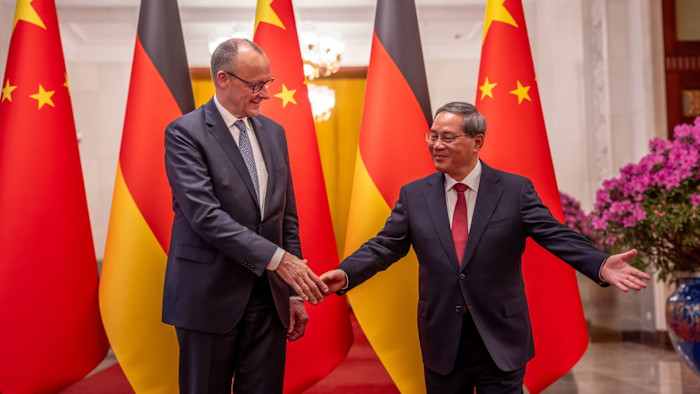
Friedrich Merz met China’s second-ranked official Li Qiang on Wednesday, kicking off a visit to Beijing in which the German chancellor is expected to confront mounting trade tensions between the EU and the world’s second-largest economy.
The Chinese premier welcomed Merz, who is making his first trip to the country in office, with an honour guard at the Great Hall of the People in Beijing, according to state media.
The pair of officials retired for talks where the German leader is expected to discuss Chinese industrial “overcapacity”, as well as business opportunities. Merz is set to meet China’s President Xi Jinping later in the day.
Before boarding his plane in Germany, Merz said he would seek to forge a “balanced, reliable, regulated and fair” partnership with Xi, adding that he would address China’s “export restrictions” and competitive “distortions”.
The two-day trip comes as Europe’s largest economy faces intensifying deindustrialisation pressures and competition from low-cost producers in China in areas such as cars and machine tools — industries at the core of Europe’s export-oriented manufacturing sector.
German industrial companies shed more than 120,000 jobs in 2025, according to EY’s estimates.
Merz, who is being accompanied on the trip by representatives of 30 companies, will also seek to emphasise the benefits of a rebalanced relationship. Many large German groups, including carmakers, still see the Chinese market as crucial for profits and innovation.
“[The] high-level trade delegation . . . fully demonstrates Germany’s strong desire to deepen bilateral trade and economic relations,” state news agency Xinhua said on Wednesday.
Merz’s trip follows a progression of visits to Beijing by European leaders including the UK’s Sir Keir Starmer last month and France’s Emmanuel Macron in December.
Beijing has sought to capitalise on the visits to project itself as a reliable defender of a multilateral trading order and amplify rifts between the US and its allies over President Donald Trump’s chaotic tariff policies and ambitions to take over Greenland.
But China has struggled to overcome deep scepticism in Europe over its growing trade surpluses and its tacit support for Russia’s war in Ukraine, according to diplomats in Beijing.
Germany’s trade deficit with China, its largest trading partner, rose to a record €87bn last year, up €20bn from 2024.
“The unilateralism and protectionism pursued by the US have prompted European countries to reassess their external relations,” said China’s Communist party mouthpiece, the Global Times.
It added that Beijing was “a firm supporter of free trade” and “aimed at upholding the international system centred on the United Nations”.