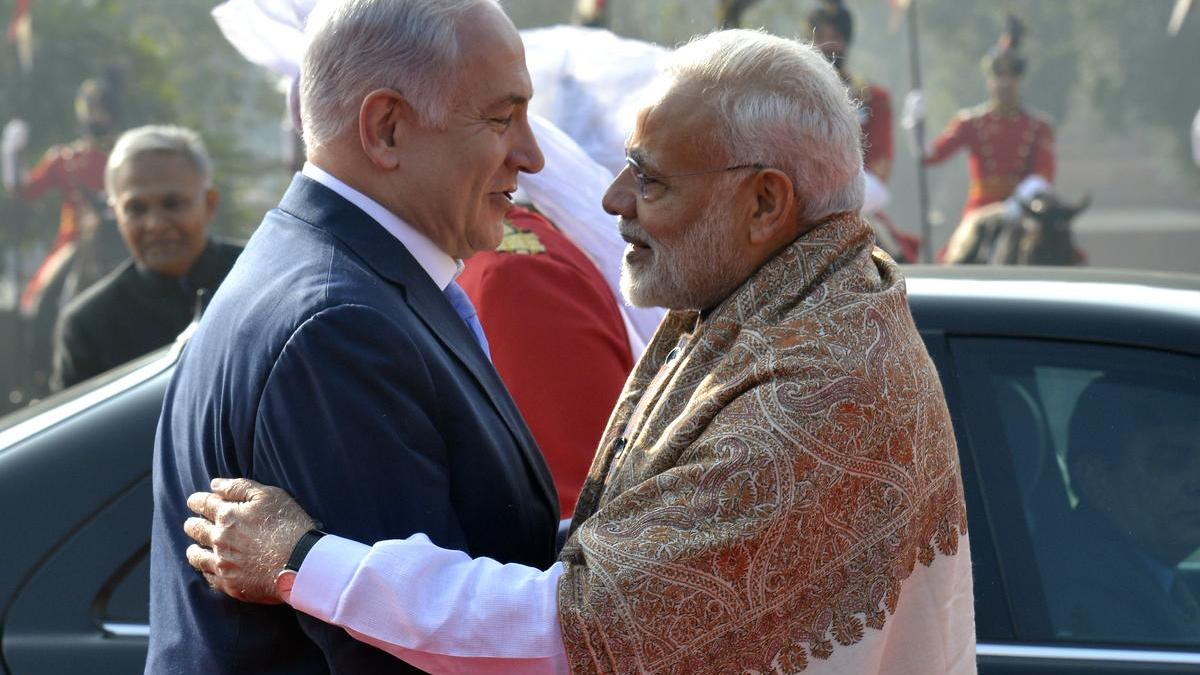
As Prime Minister Narendra Modi prepares for a stand-alone visit to Israel on Wednesday (February 25, 2026) to upgrade bilateral relations, its timing faces geopolitical headwinds. While defence and security, labour and trade, AI and technology, and IMEC project connectivity will be at the top of the agenda for his meetings with Israel Prime Minister Benjamin Netanyahu, the outcomes will go beyond bilateral agreements to their symbolism and the message they send to the wider West Asian region.
Over the course of the 24-hour visit from February 25 to 26, most of the engagements planned will see the leaders together. Mr. Netanyahu will receive Mr. Modi at the airport in Tel Aviv, as he did during the last visit in July 2017, and the two leaders are expected to travel together to Jerusalem. Apart from bilateral talks and press statements on Thursday, they will both attend Mr. Modi’s address to the Knesset, a private dinner, an innovation event, a visit to the Yad Vashem Holocaust memorial museum and possibly a meeting with the diaspora in Israel, billed as an interaction with the “Indian-Jewish” community settled there.
In particular, Mr. Netanyahu’s plans to announce a “hexagonal alliance” with India, Greece and Cyprus, and some unnamed Arab, African and Asian countries against “both radical Sunni and Shia axes”, will be watched closely by those countries seen to be targeted, including Iran, Türkiye, Saudi Arabia and Qatar, each of which has historical and complex ties with India. Any announcements on trilateral cooperation between India, the UAE and Israel during the visit will also have an impact in the region, where UAE-Saudi tensions are rising.
“The intention here is to create an axis of nations that see eye-to-eye on the reality, challenges, and goals against the radical axes, both the radical Shia axis, which we have struck very hard, and the emerging radical Sunni axis,” Mr. Netanyahu told his cabinet while announcing Mr. Modi’s visit on Sunday (February 22, 2026). The comments came just as U.S. Ambassador to Israel Mike Huckabee said in an interview that it “would be fine” if Israel were to take control of most of the biblical Middle-East or West Asia, leading commentators to draw a link between the remarks.
To travel to Tel Aviv, Mr. Modi will also have to navigate U.S. President Donald Trump’s threats to attack Iran, both literally and figuratively, amid a U.S. military build-up and withdrawal of personnel from key bases across West Asia. While attacks do not appear likely this week, given Iran-U.S. talks on Thursday, it must be remembered that U.S. strikes on Iran’s nuclear facilities in June 2025 took place even as negotiations were ongoing. Facing questions over India’s travel advisory asking citizens in Iran to leave the country, Foreign Secretary Vikram Misri said at a parliamentary committee meeting on Monday (February 23, 2026) that the Prime Minister’s security would be ensured in the event of bombardment of Iran. However, New Delhi would also have to consider the optics of being caught in cross-fire between Iran and Israel, just as Mr. Modi will be standing shoulder to shoulder with Mr. Netanyahu.
The visit could affect India’s ties with Iran directly, a country that borders South Asia and has long offered India energy and connectivity options. In deference to Mr. Trump’s sanctions, the Modi government stopped importing Iranian oil in 2017. Trade and investment declined subsequently, and more recently development of the Chabahar port terminal has been curtailed. In January, New Delhi put off the scheduled visit of Iranian Foreign Minister Abbas Araghchi and has not yet rescheduled it. Later this year, New Delhi is expected to host the BRICS summit, where Iranian President Masoud Pezeshkian will be invited.
Mr. Modi’s visit, the first since the two-year Israeli war on Gaza in which more than 70,000 were killed, also coincides with Israel’s plans to extend control over more territories under the Palestinian Authority in the West Bank, which has sparked international condemnation. India was hesitant to join a statement at the United Nations, eventually signed by 100 countries criticising Israel’s violations of international law over the plans, and the Indian mission signed it a day after it was announced at a joint press conference by dozens of diplomats. When asked last week, the Ministry of External Affairs spokesperson blamed the Palestinian mission and others for proceeding too early with a statement that was not “jointly negotiated”.
However, the government did not explain why it delayed, while countries such as the U.K., Australia, Japan, Germany and France signed immediately. Mr. Modi’s talks with Mr. Netanyahu on the future of Gaza will also be significant, given the U.S. “Board of Peace” plans for reconstruction, administration and peacekeeping of the Gaza Strip, and India’s decision to participate only as an observer at the first meeting in Washington. As Israel heads to elections later this year, Mr. Netanyahu faces calls for security accountability over the October 2023 terror attacks, and Mr. Modi’s comments during the visit will be scrutinised by Israeli opposition parties, which have threatened to boycott the Knesset speech over the tussle between the Israeli government and the Supreme Court.
Finally, the visit comes as documents released by the U.S. Department of Justice on communications by convicted sex trafficker and investor Jeffrey Epstein, who had close links to Israeli leaders including a former Prime Minister, have triggered controversies and resignations in several countries. The Ministry of External Affairs strongly denied and dismissed Mr. Epstein’s claim in a conversation with a Qatari interlocutor that he and Mr. Trump had in some way guided Prime Minister Modi’s last visit to Israel in 2017.
Published – February 24, 2026 04:00 pm IST