
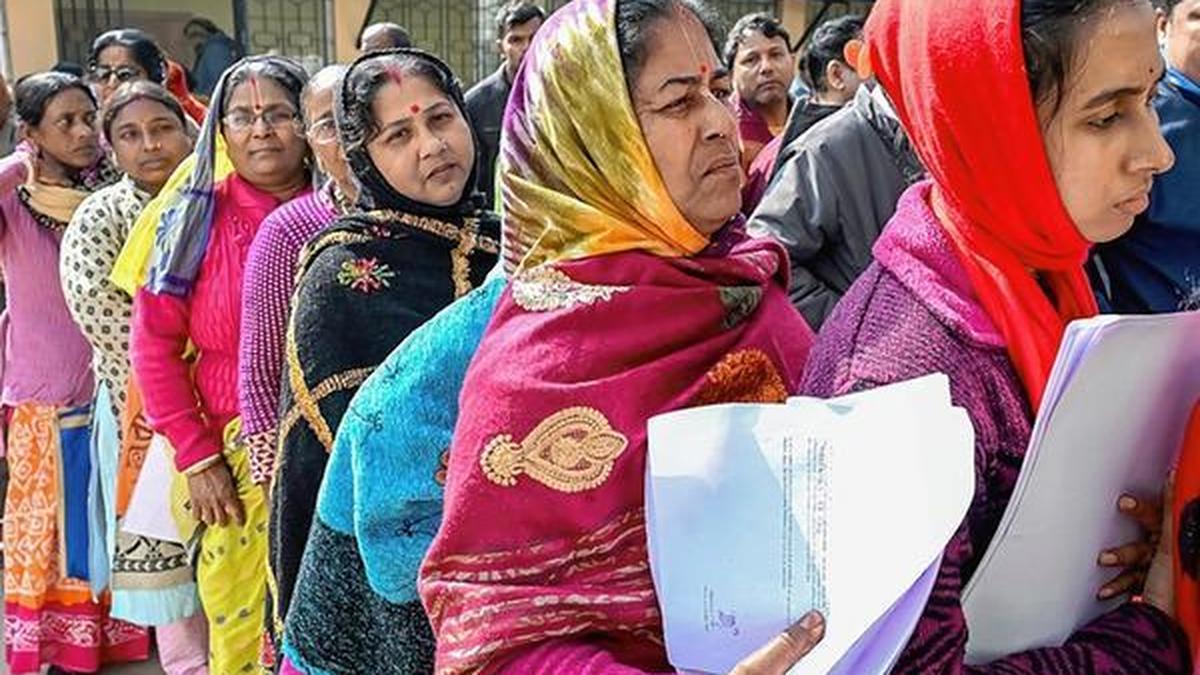
People wait in a queue during hearings under the Special Intensive Revision (SIR) of electoral rolls, in Nadia, West Bengal. File
| Photo Credit: PTI
The Union Ministry of Home Affairs (MHA) on Friday (February 21, 2026) notified another empowered committee comprising Census, postal and Intelligence Bureau (IB) officials in West Bengal to fast-track hundreds of pending citizenship applications under the Citizenship Amendment Act (CAA) amid the Special Intensive Revision (SIR) of electoral rolls in West Bengal.
Several people belonging to the Matua community, comprising Hindu Namasudras with roots in Bangladesh, have applied for citizenship under the CAA as their names are not there in the 2002 electoral list, the threshold for the ongoing SIR exercise.

A government source said though an Empowered Committee headed by the Director, Census Operations to process CAA applications, exists in all States, another such committee headed by the Deputy Registrar General, Directorate of Census Operations, West Bengal has been notified only for Bengal in the wake of deluge of citizenship requests.
“This is an additional committee that will process and fast-track CAA applications in West Bengal,” said the source.
The committee will comprise an officer in the Subsidiary Intelligence Bureau not below the rank of Deputy Secretary, two Under Secretary rank officials to be nominated by the Foreigners Regional Registration Officer (FRRO) and National Informatics Centre of West Bengal, respectively and the Post Master General of the State.
A representative from the office of the Principal Secretary (Home) or Additional Chief Secretary (Home) of the State government of West Bengal and a representative of the jurisdictional Divisional Railway Manager of Railways would be the special invitees, the notification said.
On March 11, 2024 days ahead of the announcement of the general elections, the MHA notified the Citizenship Amendment Rules, 2024 enabling the implementation of the CAA, four years after the legislation was passed in 2019.

The Act facilitates citizenship to undocumented people belonging to Hindu, Sikh, Buddhist, Parsi, Christian and Jain community from Pakistan, Bangladesh and Afghanistan who entered India on or before December 31, 2014 and fast-tracks the process by reducing the eligibility to five years continuous stay instead of 12 years.
Though the legislation was brought in for undocumented migrants, the Rules mentioned several documents to be provided by the applicants, including a document issued by a government authority in Pakistan, Afghanistan and Bangladesh.
Though earlier, several members of the Matua community were sheepish about applying under the CAA as they came from Bangladesh without any documents, after the SIR was announced in West Bengal, there has been a significant increase in such requests.
Considerable presence
The Matuas began migrating from Bangladesh in 1947 and continued to arrive in India both before and after the war in 1971 that liberated what was then East Pakistan from West Pakistan. In West Bengal, the community has a considerable presence in border districts such as North 24 Parganas, Nadia, Howrah, Cooch Behar, and Malda, and are the State’s second largest Scheduled Caste community.

As the CAA was opposed by many States, including West Bengal, Tamil Nadu and Kerala, in order to bypass the role of the State government in implementing the law, the MHA notified committees headed by Census and postal department officials who are Central government functionaries, leaving no scope for the involvement of State government officials.
Citizenship is a subject under the Union List of the Constitution and the State’s role could have come in play in providing logistics such as office space and police verification of applicants.
Published – February 21, 2026 01:18 am IST