Unlock the Editor’s Digest for free
Roula Khalaf, Editor of the FT, selects her favourite stories in this weekly newsletter.
Senior German defence officials have pledged to channel more money into innovation and start-ups amid mounting criticism over how the country’s vast military budget is being spent.
After years of missing its Nato spending targets, Berlin has unleashed hundreds of billions of euros on rearmament following Vladimir Putin’s full-scale invasion of Ukraine in 2022.
But much of the spending has gone on big-ticket items, including 35 US-made F-35s, Eurofighter Typhoons, Chinook helicopters and new warships and submarines. Orders for thousands of tanks and armoured vehicles are also being prepared.
The decisions have prompted some analysts and new entrants to raise concerns over Germany for ploughing too much money into conventional weapons such as tanks — mostly to the benefit of established arms makers — rather than unmanned weapons powered by AI.
Acknowledging the debate, defence minister Boris Pistorius said that the EU’s largest nation would do “more and more investment in innovation, more investment in new technologies, more co-operation with start-ups, and more co-operation between start-ups and the Bundeswehr”.
Speaking at this weekend’s Munich Security Conference, where he was challenged over whether Berlin was preparing “for the old war or for the new one”, Pistorius promised that he and officials “learn every day” from the war in Ukraine and the fast pace of innovation on the battlefield.
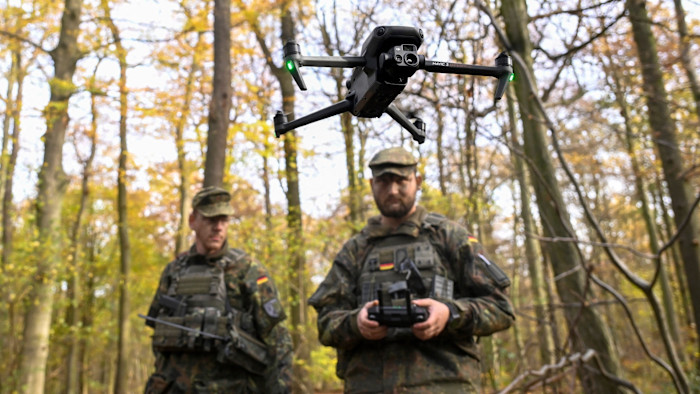
“If anybody had told us five years ago that drones would play such a relevant and crucial role, nobody would have believed or could have imagined that,” he said.
The head of the German army Christian Freuding said that soldiers still needed “traditional systems like battle tanks, howitzers”. But he added that the military must also “foster our innovative spirit” and think “unthinkable thoughts”.
Düsseldorf-based Rheinmetall estimates that it secured about 40 per cent of a €100bn special defence fund announced by Germany in 2022, and hopes to keep up that rate as hundreds of billions more are contracted in the years ahead.
Florian Seibel, co-founder of German surveillance drone company Quantum Systems, singled out Rheinmetall as he warned that Berlin was failing to spend enough on autonomous systems and AI.
“Spending €500bn out of Germany alone, of which €495bn would go to Rheinmetall and the like is not what is needed . . . there is enough money but we are spending it on the wrong things,” he said.
“We’re going to spend hundreds of billions in equipment that will sit in graveyards and my kids and my grandchildren will still have to work for the debt to pay back to the banks.”
Although Quantum is one of several start-ups to have won drone contracts from the Bundeswehr in recent months, the sums represent a fraction of the total spending in a nation with a total defence budget of €118bn this year.
Moritz Schularick, head of the Kiel Institute for the World Economy, estimates that “95 or 98 per cent” of German defence spending since 2022 has gone into “traditional legacy procurement”.
Schularick, who is also an adviser to Germany’s economy ministry on the defence industry, warned at the conference that the current approach was failing to make Europe ready to confront Russian aggression as well as missing out on the wider economic benefits of supporting agile and innovative young companies.
“We need to reserve a much bigger share for the procurement of innovation, knowing that some of these things are not going to work out.”
“You define the problem and you let the private sector figure out how to get there instead of having very long bureaucratic processes top down, specifying to the last screw how the problem is solved,” he added.