Unlock the White House Watch newsletter for free
Your guide to what Trump’s second term means for Washington, business and the world
The US has said it took military action against what it claimed were Mexican cartel drones that had crossed into American airspace, temporarily closing airspace around the border city of El Paso, Texas.
“Mexican cartel drones breached US airspace,” said an administration official on Wednesday. The Pentagon “took action to disable the drones”.
The Federal Aviation Administration and defence department “have determined there is no threat to commercial travel”, the official added.
US transportation secretary Sean Duffy, whose department oversees the FAA, wrote on X that the aviation agency and Pentagon “acted swiftly to address a cartel drone incursion”.
Washington did not provide any more details about the incident or how the drones were disabled.
However, Veronica Escobar, who represents El Paso in the US House of Representatives, rejected the Trump administration’s explanation, saying it “does not add up” and that it was not the information shared with Congress.
She added that the airspace closure did not appear politically motivated.
Drone incursions from Mexico are “not unusual” and “there was nothing extraordinary . . . in any drone incursion into the US that I’m aware of”, Escobar told reporters in Washington.
“There have been drone incursions from Mexico going back to as long as drones existed. So this is nothing new,” she said, adding that they were “obviously not something any of us want to see”.
Mexican President Claudia Sheinbaum said “we have no information of the use of drones on the border”.
She added that if the US had any indication that drones had crossed into US airspace, “they can ask the Mexican government”.
“We must not speculate” about what happened, she said.
“The temporary closure of airspace over El Paso has been lifted,” the FAA said on X on Wednesday. “All flights will resume as normal.”
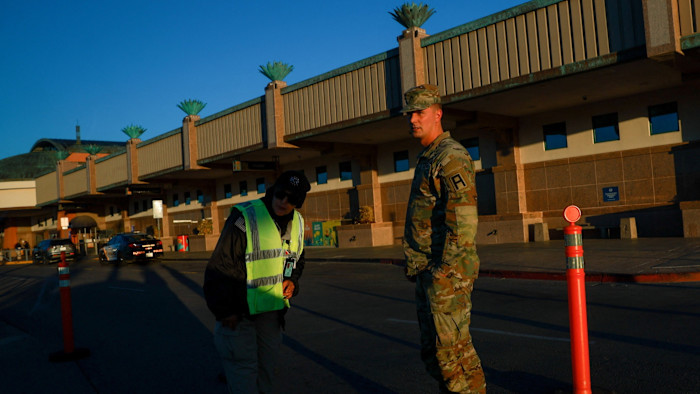
The US abruptly closed the airspace around El Paso International Airport late on Tuesday night for 10 days citing mysterious “special security reasons”, with the FAA classifying the area as “national defence airspace”.
The closure brought to a halt all flights in and out of the airport, and would have caused significant travel disruption over the 10-day period. Airspace was also closed around neighbouring Santa Teresa, New Mexico. It has yet to reopen.
Escobar said she knew why the Santa Teresa restrictions remained in place, but was not able to provide details.
Mexican airspace was excluded from the FAA’s restrictions.
El Paso is the 23rd most populous US city, with nearly 700,000 inhabitants, and borders the Mexican city of Ciudad Juárez, with which it shares strong economic and cultural ties.
It is also home to Fort Bliss, a US army post located next to the city’s airport. About 45 miles north of Fort Bliss is the army’s White Sands Missile Range in New Mexico.
The Pentagon said it had nothing more to share about the incident or the military action taken against the drones. Fort Bliss did not immediately respond to a request for comment.
Asked whether the FAA’s decision was related to anti-drone technology at Fort Bliss, Escobar said “there was nothing happening” at the base that would have necessitated the closure of airspace.
She declined to say whether miscommunication between the FAA and the defence department was a factor in the airspace closure.
Roughly 3.3mn passengers flew through El Paso airport in the first 11 months of 2025, according to Cirium, an aviation data analytics firm. There were approximately 120 flights scheduled in and out of the El Paso airport for Wednesday, according to FlightAware.