Stay informed with free updates
Simply sign up to the EU economy myFT Digest — delivered directly to your inbox.
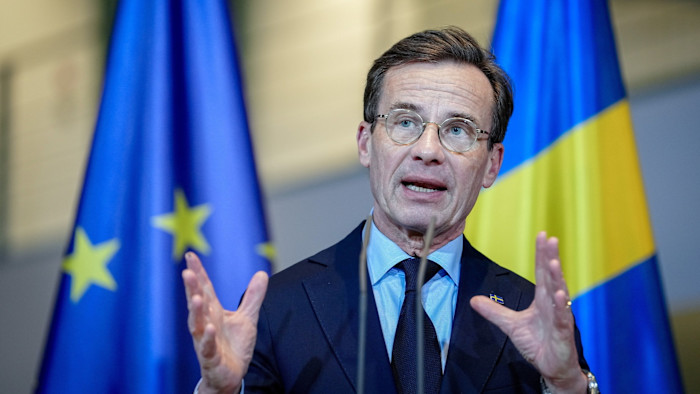
Swedish Prime Minister Ulf Kristersson has warned that Europe cannot be successful by adopting a protectionist agenda as promoted by France, ahead of an EU summit focused on how to revive the European economy and reverse widespread deindustrialisation.
French President Emmanuel Macron has pushed for a Buy European policy that would require certain key goods to be made within the bloc despite higher costs. But Sweden, one of the most vocal advocates for an open economy, free trade and deeper integration of the bloc’s single market, has balked at this proposal.
“The basic idea of trying to protect European business, if that is the purpose of Buy European, to try to avoid trading with or partner with other countries, then I’m very sceptical,” Kristersson told the FT in an interview. “We need to be able to compete because of quality and because of innovation, not because we try to protect the European markets.”
EU leaders will meet on Thursday to brainstorm ideas to save the continent’s ailing economy as it comes under pressure from cheap Chinese imports, US tariffs and painfully high energy prices.
But the Swedish premier said that a more protectionist agenda would not help: “We do not want to protect European businesses that are basically not competitive.”
Kristersson acknowledged that EU companies faced tough competition from China due to slowing consumer spending in Europe and vast subsidies doled out by Beijing, and that the bloc had been slow to respond to companies’ concerns.
The phaseout of cheap Russian gas following Moscow’s full-scale invasion of Ukraine sent energy prices soaring in 2022 at the same time as the EU’s ambitious climate agenda cut into business margins, causing hundreds of plant closures and curtailing industry’s ability to invest.
Progress has been slow because of competing national interests and limited bandwidth for issues beyond Russia’s war in Ukraine and US President Donald Trump’s tariffs and hostile bid to take over Greenland, the semi-autonomous Danish territory.
Kristersson admitted that there would be “competing national traditions and political wills” around the table on Thursday, which would stymie efforts to find a common path forward.
“[From] a lot of European businesses the main objection I quite often hear is that things just simply take too much time,” Kristersson said. “Sometimes Europe is exactly as slow as the Americans suspect we are.”
“There is a lack of common action right now . . . the world as it is right now also demands us to be more — I won’t use the word sovereign — but step up in different ways.”
Kristersson said he was broadly supportive of a call by former ECB president Mario Draghi for “pragmatic federalism” inside the EU whereby coalitions of countries go ahead with decisions blocked by one or a minority of states for political reasons — as has been the case with Hungary.
European Commission president Ursula von der Leyen this week also backed that concept by saying there should be more “enhanced co-operation” where there is no consensus among the bloc’s 27 members.
The Swedish premier said: “If we are to wait for everybody to come on board in everything I think it would simply become too slow. I do think that ‘coalitions of the willing’ is a way forward, without at all neglecting the fact that . . . it can collide with internal market rules.”
European businesses have become increasingly dejected at the lack of progress in advancing decades-old plans to cut barriers in the single market and improve intra-EU trade and investment. Industry chiefs will gather in Antwerp on Wednesday to air their woes to EU leaders and commissioners ahead of the Thursday gathering.
“There is absolutely a very fair and legitimate lack of patience right now in European business,” said Kristersson.
“[But] it’s not to say that the rest of the world is perfect and Europe is not. Absolutely not,” he added. “We have our advantages as well. I think we should build more on those advantages. And the biggest one we have is the internal market.”