
Stay informed with free updates
Simply sign up to the Equities myFT Digest — delivered directly to your inbox.
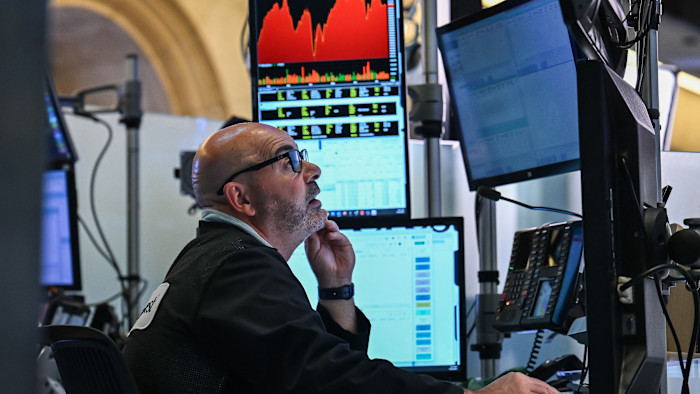
US tech stocks were hit by a fresh wave of selling on Wednesday as disappointing results from a big chipmaker fuelled a sell-off sparked by concerns about the impact of AI on software businesses.
The tech-heavy Nasdaq Composite fell 1.5 per cent and the benchmark S&P 500 index slipped 0.5 per cent, extending Tuesday’s declines.
The moves came as chipmaker AMD closed 17.3 per cent lower after it reported its earnings, its biggest fall since 2017.
AMD reported strong first-quarter sales guidance and higher than expected revenue in the fourth quarter of last year, but “expectations [had] gotten a bit too high” in the run-up to its results, Jefferies’ analysts said.
One-off data centre-related sales to China had also accounted for a larger than anticipated share of its revenue, analysts said.
Rival chipmaker Qualcomm’s disappointing sales outlook knocked its shares after the market closed. They fell about 9 per cent.
Qualcomm said it expected $10.6bn in revenue in the current quarter compared to the $11.2bn that Wall Street was expecting. It reported $12.3bn in revenue for the previous quarter, in line with expectations.
Other stocks linked to AI were caught up in Wednesday’s sell-off. Palantir, previously an AI high-flyer, fell 11.6 per cent and memory manufacturer SanDisk dropped about 16 per cent. Chipmaker Broadcom fell 3.8 per cent, software group Oracle lost 5.1 per cent and Nvidia fell 3.4 per cent.
Bitcoin, a speculative asset that typically falls when investors are uneasy, declined 3.1 per cent to $73,318, bringing its loss for 2026 to 17 per cent.
“The current indiscriminate sell-off resembles the DeepSeek-driven decline of January 2025, which ultimately proved unfounded,” Bank of America analyst Vivek Arya said on Wednesday, referring to the hundreds of billions of dollars briefly wiped off the value of major US tech stocks by the advances of the Chinese AI start-up early last year.
Software stocks have sold off sharply in recent months and were hit particularly hard on Tuesday following the recent release by AI group Anthropic of marketing, legal and finance additions to its Claude Cowork tool.
A JPMorgan index tracking US software stocks has dropped 18 per cent since the start of the year and is close to its lowest level since Donald Trump’s so-called liberation day tariffs rattled global financial markets last April.
“This concept that AI will cannibalise the most tech-savvy firms first is an interesting new narrative in the AI story arc,” said Mike Zigmont at Visdom Investment Group.
“Until the market either rejects the narrative or modifies its existential consequences, it will be difficult for tech to resume its bullish trend,” he added.
European stocks in the sector also dropped. The London Stock Exchange Group closed slightly lower, adding to a 12.8 per cent fall on Tuesday. FTSE 100 media and data company Relx finished the day 1.3 per cent lower, after shedding 14.4 per cent in the previous session.
Advertising companies were also hit, with Publicis declining another 2.2 per cent on top of 9.2 per cent on Tuesday, and WPP dropping a further 3.7 per cent after Tuesday’s 11.8 per cent fall.
Jim Reid, head of macro research at Deutsche Bank, wrote: “Recent months have seen a clear shift in markets from AI euphoria towards more differentiation between companies, and growing concern about its disruption to existing business models.”
Shares of several software companies listed in Asia fell sharply earlier on Wednesday, including Australia’s Xero, China’s Hong Kong-listed Kingsoft Corporation and Indian IT services groups Infosys and Tata Consultancy Services.
Marija Veitmane, head of equity research at State Street, said the “apocalyptic” reaction by the market was “overly pessimistic” about the impact of the new technology on some of the data companies.
“I don’t think we can completely replace data analytics and software writing,” she said. “Of course, there is adjustment, but those companies will end up being more efficient.”
“It’s incremental improvement, rather than total revolution.”